
Fitness trackers and wearables have been in the news lately for their ability to pick up data points that could predict a COVID-19 infection. It is speculated that these fitness tracers could predict a COVID infection by tracking parameters such as respiration rate and daily step count. It is estimated that 21% of all Americans wear a fitness tracker and an estimated 25 million of these devices where sold in 2019. With so many Americans wearing fitness trackers, they could play a vital role in helping us catch COVID infections earlier and possibility prevent future spread of the virus.
One such wearable, the Whoop strap, has claimed that they can predict a COVID infection two days prior to developing symptoms. I have been using the Whoop strap since September 2020 and I have enjoyed the insights that I have gleaned from it's (sometimes overwhelming) extensive weekly and monthly reports. One of the data points that I use daily is the Recovery Score. Whoop generates a daily Recovery Score using 4 metrics; Heart Rate Variability (HRV), Resting Heart Rate (RHR), Sleep and Respiratory Rate (# of breaths/minute). Based on your recovery score, Whoop creates your recommended daily Strain which is a numerical value that represents how hard you should push yourself during exercise.
On January 2nd, I got on my bike trainer and picked a 1.5 hour workout. When I reached the 20 minute mark I knew I wasn't going to finish the ride. I never felt short of breath, but I had very little stamina. I pushed to 30 minutes and decided to call it, which is unusual. That evening I started to feel fatigued and I started to experience a headache behind my eyes. That night was miserable and the next morning when I checked my Recovery score I was shocked to see that it was 1%. Even at my most fatigued, I had never seen a score close to 1%.
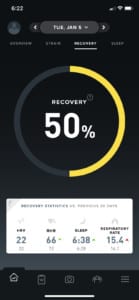
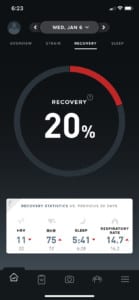
Could I have seen this coming based on my Whoop data? Let's look at my Recovery Score for the two days prior to the start of my symptoms. It is important to remember that the data from the Recovery Score represents the tracking from the night before.
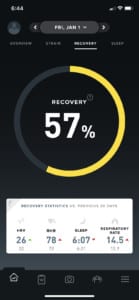
Recovery Score from the Night of 12/31
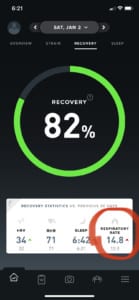
Recovery Score for the night of 1/1
What do these Recovery Scores tell us?
First Whoop color codes the Recovery Score; Yellow represents moderate recovery and Green represent significant recovery. Both yellow and green recovery scores allow for an increased level of Strain (exertion) for the day. I would typically be happy with either one of these Recovery Scores and see this as a sign that I have recovered well. What I didn't notice in these scores was an increase in Resting Heart Rate and increased Respiratory Rate. While I have seen my Resting Heart Rate close to these levels (typically related to alcohol consumption), these are the highest Respiratory Rates that I have seen since I started using Whoop. I don't know how much weight Whoop gives to each data point, but it seems that Heart Rate Variability is weighted higher than the other data points when generating the Recovery Score.
The next two days day- January 3rd and 4th
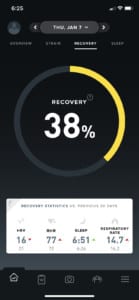
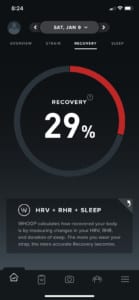
As I mentioned, the night of the 2nd was miserable so I decided to get tested in the afternoon of the 3rd which came back positive. The night of the 3rd was equally miserable. Here are the Recovery Scores from those days.
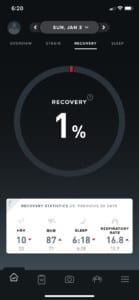
Night of the 2nd
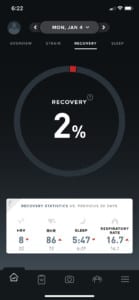
Night of the 3rd
My Respiratory Rate has averaged around 13 and now was almost 17. I never paid much attention to the Respiratory Score because it has been consistent with only small fluctuations.
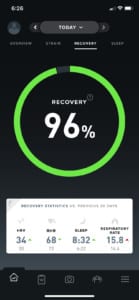
On the third day I began to feel better and headache finally eased. The fourth day came with an ear ache that lasted a couple days. Today my Recovery Score was a 96% and I can say that I am feeling significantly better. While I never felt like I had trouble breathing, my Respiratory Rate did indicate that I was taking more breaths per minute than I had previously. Even though my score today was a 96%, my Respiratory Rate has not returned to my norm.
In hindsight I would say that my Whoop strap gave me the data that showed that there was a potential COVID infection brewing, but without a COVID test prior to Jan 3rd it is hard to know for certain if I was infected. Had I put more stock in the Whoop data I might've detected a COVID infection prior to the onset of symptoms but that is pure speculation.
COVID is obviously on the top of everyones brain, but when we get past this pandemic how can we use this data? These data points might be able to tell us when our bodies are not at an optimal place and remind us to listen to our bodies and give it a chance to recover in order to stay healthy. If these wearables can tip us off to small inconceivable changes in our body that can negatively affect our health, we might learn to notice these changes without the aid of a wearable.




