
You brush your teeth every day. Could that familiar routine also help you remember to work on your balance?
Yes—as a reminder to practice regularly. For a safer starting point, finish brushing, put the toothbrush down, and give balance practice your full attention. A short, supported exercise can be easier to remember when it follows something you already do.
Balance helps you stay steady when you step off a curb, turn around, get dressed, or walk across an uneven surface. It involves more than strong ankles: your vision, inner ear, sensation, and muscles all contribute.
Balance exercises can improve stability and are an important part of fall prevention for older adults. They work alongside strength and other physical activity. A brief bathroom routine can be a starting point, rather than a complete exercise program. National Institute on Aging: Exercise and balance
Balance practice belongs in more than a fall-prevention plan. Children and teens use balance while playing, landing, and changing direction. Younger and middle-aged adults rely on it for hiking, running, recreational sports, and everyday tasks. Later in life, maintaining balance helps support independence and confidence on your feet. The challenge should fit the person’s ability, rather than age alone.
Running involves repeatedly supporting your body on one leg. Your foot and ankle, knee, and hip work together to manage each landing and prepare for the next step. Balance practice challenges your ability to control that position and respond to changes underfoot.
For runners, balance work can be one part of a plan to look after the feet, ankles, and knees, alongside strength training, gradual changes in mileage, and adequate recovery. Balance and movement-control exercises are commonly included in ankle rehabilitation, and single-leg tasks help clinicians assess readiness to return to running after a knee or ankle injury. AAOS: Sprained ankle · Johns Hopkins: Returning to running after a knee or ankle injury
A supported standing exercise is a useful starting point, but it does not reproduce the speed and impact of running or guarantee that you will avoid injury. If you have recurring foot or knee pain, or an ankle that gives way, an assessment can help identify which exercises and training changes are appropriate.
Choose a dry, level, uncluttered area with a sturdy counter or wall for support. If the bathroom is cramped or the floor is slippery, move to a better spot. Wear stable footwear that grips the floor, and keep your eyes open.
If you have fallen recently, feel dizzy, use a walking aid, or already struggle to stand steadily, get individual guidance before trying a new balance challenge. Keep any prescribed walking aid available.
Stand facing a sturdy counter, with your feet comfortably apart and both hands resting on the surface. Gently shift a small amount of weight toward one foot, then back toward the other, keeping both feet on the floor.
Move slowly and stay within a range that feels controlled. This is a chance to notice your movement, not a test of how far you can lean. If you feel unsteady, stop and return to a comfortable stance.
If standing and shifting feel comfortable, a supported one-leg stand may be an appropriate next step:
Use as much hand support as you need. If you cannot hold the position comfortably, lower your foot sooner. The NHS includes this type of supported exercise in its beginner balance routine. NHS: Balance exercises
Keep the toothbrush out of your mouth during practice. Avoid adding closed eyes, unstable cushions, or other distractions to make the exercise harder.
Try linking your practice to finishing your morning brushing on a few days each week. Choose a manageable version you can repeat comfortably. Regular practice matters more than competing with yesterday’s hold time.
If an exercise becomes easy, ask a qualified clinician how to progress it. Balance training should match your ability and health history.
Stop if you develop dizziness, pain, or a feeling that you might fall. New or worsening unsteadiness deserves an assessment rather than more challenging exercises.
At Compass Chiropractic, we can discuss your movement concerns, assess relevant musculoskeletal limitations, and help identify appropriate next steps, including referral when needed.
Your toothbrush can remind you to start. A safe space, steady support, and consistent practice are what make the routine useful.
There’s nothing quite like spending the holidays with family—until you meet the guest bed.
Maybe it’s the mattress from your spouse’s childhood bedroom. Maybe it’s a pullout couch with a bar you can locate without looking. Or maybe the bed is perfectly fine, but it feels nothing like yours.
You may not be able to change the mattress, but a little preparation can make an overnight visit more comfortable.
If space allows, bring your usual pillow. It’s one familiar part of your sleep setup you can take with you.
Once you lie down, check whether your head feels comfortably supported. A stack of fluffy guest pillows might look inviting, but you don’t have to use all of them. Adjust the arrangement if your chin feels pushed toward your chest or your head is tipped awkwardly.
The goal is comfort, rather than forcing yourself into a particular position.
An extra pillow can support more than your head.
If you sleep on your side, try placing a pillow between your knees with your legs slightly bent. If you sleep on your back, a pillow beneath your knees may make your lower back more comfortable. These are common positioning options for people with back pain; keep the arrangement that feels best for you. Mayo Clinic: Sleeping positions that reduce back pain
Ask your host for an extra pillow before bedtime so you’re not searching the linen closet at midnight.
Holiday visits often mean later dinners, more conversation, and a different schedule. Keep a few parts of your usual routine when you can.
Give yourself some quiet time before bed, make the room comfortably cool and dark, and aim for a reasonably consistent sleep schedule. Be mindful of late caffeine and alcohol near bedtime, both of which can interfere with sleep. An eye mask or earplugs may also be useful in an unfamiliar room. NIH: Healthy sleep habits
You don’t need a perfect evening routine. A few familiar cues can help you settle in.
Before jumping into breakfast duty or carrying luggage downstairs, take a moment to see how you feel.
Sit up at a comfortable pace, stand when you’re ready, and take a short walk around the room or hallway. If gentle movement feels good, ease into your day. Skip forceful stretches or attempts to “crack out” a stiff area.
A rough night is also a good reason to ask for help with a heavy suitcase.
If the sleeping arrangement is clearly uncomfortable, speak up. A different bed, a mattress topper your host already has, or another available sleeping space may be worth trying.
And if pain persists, keeps returning, or interferes with your normal activities, arrange an evaluation. An unfamiliar bed may be part of the story, but it shouldn’t automatically take all the blame.
At Compass Chiropractic, we can assess recurring neck discomfort or back discomfort and help you understand appropriate next steps.
The best holiday memories usually happen outside the guest bedroom. A familiar pillow, a few thoughtful adjustments, and an unhurried morning may help you enjoy more of them.
You’re planning Thanksgiving dinner, keeping track of school events, and trying to get ahead on holiday shopping. Then you notice it: your shoulders are creeping toward your ears, your jaw is clenched, and you’ve been gripping the steering wheel for the last ten minutes.Sound familiar?Stress can show up physically, including muscle tension and pain. During a busy holiday season, it’s worth checking in with your body as well as your calendar. NHS: Recognizing stress
A parent’s guide to comfortable movement, court awareness, and knowing when to ask for help.
When you watch your child play basketball, you probably notice their shot, footwork, and hustle. Their neck may never cross your mind—until they come home stiff or have trouble looking over a shoulder.
Yet basketball asks players to look in different directions all game long. A post player checks for a defender. A guard scans for an open teammate. A rebounder looks up to track the ball.
Comfortable neck movement is part of those everyday actions. When turning the head becomes painful or restricted, it deserves attention.
“Cervical” refers to the neck. Cervical mobility means the ability to move the neck: turning to either side, looking up and down, and tilting the head.
For a young athlete, the goal is comfortable, controlled movement that meets the demands of their sport. Trying to achieve the biggest possible stretch is not the goal.
The neck also works with the eyes, shoulders, and upper back. Looking around the court involves the whole person, so an assessment should consider more than neck flexibility alone.
Think about a player receiving the ball near the basket. Before making a move, they may glance over either shoulder to locate a defender or an open teammate. Out on the perimeter, a player may turn their head to follow a cutter while maintaining their position.
These are practical examples of how head movement fits into basketball. They do not mean that increasing neck range of motion will automatically improve court vision, passing, or shooting. Basketball performance also depends on skill, decision-making, strength, conditioning, and experience.
The useful question is whether pain or stiffness is making a normal basketball movement harder for your child.
Your child may not say, “My neck movement feels limited.” They might describe tightness, soreness, or difficulty looking one way. You might notice:
Turning the body during basketball is normal. A movement becomes more worth discussing when it is new, painful, or clearly different from your child’s usual pattern. These observations can start a conversation; they do not diagnose an injury.
Start by asking what your child feels and when it happens. Encourage them to tell their coach or athletic trainer about symptoms instead of playing through them.
Outside practice, notice long stretches spent looking down at a phone or laptop. Changing positions and taking movement breaks can help interrupt prolonged positions that may contribute to neck discomfort. [1]
If stiffness persists or keeps returning, arrange an assessment before adding neck stretches or strengthening drills. Avoid forcing the head farther, pushing through pain, or having someone else stretch the neck. An individual plan should reflect your child’s symptoms, injury history, and examination.
A collision or fall changes the situation. Stop play for new neck pain or burning, tingling, numbness, or weakness in an arm, and have the athlete assessed promptly. Even symptoms that fade quickly should be reported. Athletes with a burner or stinger should not return until they have recovered and a clinician has determined it is safe. [2]
Severe neck pain after a fall or collision, weakness, symptoms in both arms or the legs, or difficulty walking requires emergency assessment. Do not test or force neck movement; call 911 for a suspected serious neck injury. [1]
At Compass Chiropractic, we evaluate non-emergency neck complaints and look at how neck, shoulder, and upper-back movement relate to an athlete’s concerns. Our team includes an athletic trainer, and we can coordinate recommendations with families and school athletic staff.
Depending on the findings, next steps may include individualized rehabilitation, appropriate chiropractic care, or referral for further evaluation. The aim is to address the cause of the limitation and work toward comfortable, controlled movement for basketball and everyday life.
If your child has recurring stiffness or difficulty turning their head, Dr. Matthew Crawford can help you understand the next step. Ask how an evaluation may help address restricted neck movement and support your player’s goals on the court.
Educational information only. Individual symptoms and return-to-play decisions require an appropriate clinical evaluation.
Holiday decorating has a way of turning an ordinary afternoon into a workout. There are bins to carry, furniture to move, and lights to hang—often with more reaching and lifting than you’ve done all week.
Before you tackle the decorations, take a few minutes to get yourself ready.
Start with a short walk around the house, a few comfortable shoulder circles, and several gentle sit-to-stands. The goal is to ease into movement before picking up something heavy.
Split heavy decorations into smaller containers, and ask for help with bulky or awkward items. Test a bin’s weight before committing to the lift, especially if it has been sitting untouched since last year.
Bring the load close to your body before lifting. Bend through your hips and knees as comfortably as you can, and turn by moving your feet instead of twisting while holding the bin. Clear the path first so you can see where you’re going.
Position yourself close to the task so you don’t have to stretch far to reach it. Use a stable ladder on level ground, follow its safety instructions, and climb down to reposition it whenever needed. Avoid standing on chairs or furniture.
Alternate overhead decorating with tasks at a comfortable height. Short breaks are also a good opportunity to check whether you’re getting tired and need to finish another day.
The decorations don’t all have to go up in one afternoon. A little preparation, smaller loads, and an extra pair of hands can make the job more comfortable—and leave you with energy to enjoy the results.
When an Indianapolis winter settles in, our routines change. We bundle up, spend more time indoors, and may go to work and come home in the dark. It is a good time to consider whether you are getting enough vitamin D.
Taking a supplement can help fill a dietary gap when sunlight becomes less reliable. The goal is to meet your needs consistently, with a dose that fits your health and the other supplements you take.
Your skin makes vitamin D in response to UVB sunlight. Season, latitude, clothing, and time outdoors affect that process. During winter, relying on sunshine alone becomes less dependable. Sunlight through a window does not produce vitamin D in your skin, and tanning beds are not a safe solution. Continue protecting your skin outdoors. NIH vitamin D guidance.
Vitamin D helps you absorb calcium and supports normal bone mineralization. It also contributes to normal muscle and immune function. Severe deficiency can cause bone pain and muscle weakness.
Those roles make adequate intake important throughout the year. However, taking extra vitamin D has not been established as a reliable way to prevent colds or flu, treat winter depression, or relieve everyday aches in people who already have enough. Persistent fatigue, low mood, or pain deserves an evaluation rather than an assumption that vitamin D is the cause. Read the NIH review of benefits and limitations.
Fatty fish such as salmon and trout provide vitamin D. Fortified milk, some plant milks, and some cereals can also contribute; check the label because amounts vary. Egg yolks provide smaller amounts.
If these foods are not regular parts of your diet, a supplement may make it easier to meet your needs during winter. Review your multivitamin and other supplements first so you know how much vitamin D you already take.
Recommended daily intake from food and supplements combined is 600 IU (15 mcg) for adults ages 19–70 and 800 IU (20 mcg) for adults 71 and older. These recommendations account for minimal sun exposure. Winter does not automatically mean everyone needs a high dose.
For most adults, 4,000 IU per day is the tolerable upper intake limit, not a daily target. Too much supplemental vitamin D can cause high blood calcium and kidney problems. A clinician may prescribe a different amount to treat an established deficiency or another medical condition. NIH recommended amounts and safety information.
It can seem puzzling that skin can make substantial amounts of vitamin D in strong sunshine while daily intake recommendations are much smaller. But the amount your skin can produce does not establish how much you need to take every day. Production varies with season, latitude, skin pigmentation, age, clothing, and the amount of skin exposed.
Sunlight also has a built-in limiting mechanism: continued exposure converts vitamin D precursors into inactive compounds, helping prevent vitamin D toxicity from sunlight. Vitamin D taken by mouth bypasses that skin mechanism. This is why estimates of vitamin D production from sun exposure cannot be translated directly into a safe daily supplement dose. NIH explanation of sunlight and vitamin D.
The 4,000 IU adult upper limit is not a point where toxicity suddenly begins. It is a boundary for routine, long-term intake intended to protect the general population. A healthcare professional may recommend a higher dose for a specific medical reason, with appropriate follow-up. That differs from recommending a higher dose to everyone throughout winter. NIH safety guidance.
Routine vitamin D testing is not recommended for generally healthy adults. Testing may be appropriate when there is a medical reason, such as a condition that interferes with nutrient absorption, low blood calcium, or suspected deficiency.
The Endocrine Society also advises generally healthy adults under 75 against routinely taking more than the recommended intake solely for disease prevention. People with an established deficiency or specific medical needs require an individual plan. Ask your healthcare professional whether testing or a different dose makes sense for you. Endocrine Society guideline.
Compass can help arrange an at-home vitamin D test through Fullscript, with a collection kit shipped directly to your house. You collect the sample at home and mail it to the laboratory for analysis, without a trip to a blood-draw center.
Fullscript offers ZRT Laboratory’s Blood Spot LCMS Vitamin D test. It measures total 25-hydroxyvitamin D, along with vitamin D2 and D3. Collection uses a finger prick and drops of blood on a collection card. This is a home sample-collection kit; the laboratory processes your sample and provides the results.
Testing is not necessary for every healthy adult, but home collection can be convenient when testing is appropriate. For testing availability and pricing, leave your name and email below. Dr. Bingham will get back to you. Availability depends on the test and your location.
Want more information about testing availability and pricing? Leave your name and email address, and Dr. Bingham will get back to you.
If a supplement fits your plan, Metagenics D3 Liquid Vitamin is available through Dr. Bingham’s Fullscript account. The liquid format can be convenient for adults and children who prefer drops to capsules. I have been using these drops for as long as I can remember. Each drop has 1,000 IUs and has a minty flavor that makes it more enjoyable especially for the kiddos.
The current label lists 1,000 IU (25 mcg) of vitamin D3 per drop. One drop is different from a full dropper. Because one drop already exceeds the adult recommended daily intake, choose the amount with your healthcare professional and account for vitamin D from other sources. Children need age-specific advice; do not use this adult discussion to choose a child’s dose.
View Metagenics D3 Liquid on Fullscript
Our practice may earn revenue from purchases through this store. Review the current product label and discuss suitability with your healthcare professional, particularly if you are pregnant, have kidney disease or high calcium, or take prescription medicines.
This winter, check your food sources, add up the vitamin D in your existing supplements, and ask for help if you are unsure about your needs. If a supplement is appropriate, a consistent routine can help you follow your plan. Vitamin D is best absorbed with a meal or snack containing some fat.
Have questions? Bring your supplement list to your next visit at Compass so we can discuss your intake and whether further medical evaluation is appropriate.
This article provides general education and does not replace individualized medical care.
Do you have pain in the front or back of your shoulder that sometimes radiates down your arm? The subscapularis is one muscle worth understanding when you’re trying to make sense of shoulder discomfort. In the video below, Dr. Bryan Bingham of Compass Chiropractic and Massage in Indianapolis explains where it sits and demonstrates a lift-off test and a massage-cane technique.
Pain in these areas does not identify the cause by itself. A shoulder, tendon, or neck-related problem can produce overlapping symptoms, so the goal is to understand the possibilities and choose the right next step.
The subscapularis is one of the four rotator cuff muscles. It lies on the front surface of the shoulder blade, between the blade and the rib cage. That position makes it harder to reach than the muscles you can easily feel across the back of your shoulder.
Its main job is to turn the upper arm inward, a movement called internal rotation. It also helps keep the shoulder joint stable as your arm moves. See the University of Washington’s subscapularis anatomy reference.
Watch Dr. Bingham’s full demonstration, including the muscle’s location, the lift-off movement, and how he positions a Thera Cane.
Video guide: 0:03 — muscle location and shoulder discomfort; 0:33 — lift-off test demonstration; 1:33 — massage-cane demonstration.
Muscle tenderness and restricted movement can be part of a shoulder-pain presentation. In the video, Dr. Bingham discusses discomfort around the front and back of the shoulder and symptoms that may extend into the arm. These patterns are a reason to examine the whole shoulder and neck, rather than assume one muscle explains everything.
Tender spots are often described as trigger points. Finding a sore spot alone does not establish a diagnosis, and it does not mean that a tendon injury or nerve problem has been ruled out. Pain traveling down the arm, especially with numbness, tingling, or weakness, deserves an assessment. Learn more about shoulder and neck-related arm symptoms.
In the demonstration, Dr. Bingham places the back of his hand against his lower back and lifts the hand away while keeping an upright posture. Clinicians use versions of this test as part of an examination of subscapularis function.
Difficulty with this movement can have several explanations, including pain, limited motion, or weakness. It is not a home test that confirms a “tight subscapularis” or rules out a tear. Avoid forcing your arm behind your back if that position hurts. Read about the role and limitations of rotator cuff examination tests.
A Thera Cane is a curved self-massage tool with knobs and handles that let you control pressure. In the video, Dr. Bingham demonstrates its placement and describes brief holds of about 10–15 seconds before releasing.
The underarm region contains nerves and blood vessels, so accurate placement matters. Ask a clinician to show you the appropriate spot before trying this technique. Use light, controlled pressure; do not dig forcefully into the armpit or chase pain down the arm. Stop if you notice sharp or electric pain, tingling, numbness, or worsening symptoms.
The manufacturer recommends short sessions when beginning, avoiding inflamed areas, and stopping if bruising occurs. Review the Thera Cane owner’s manual before use.
Affiliate disclosure: As an Amazon Associate, Compass earns from qualifying purchases.
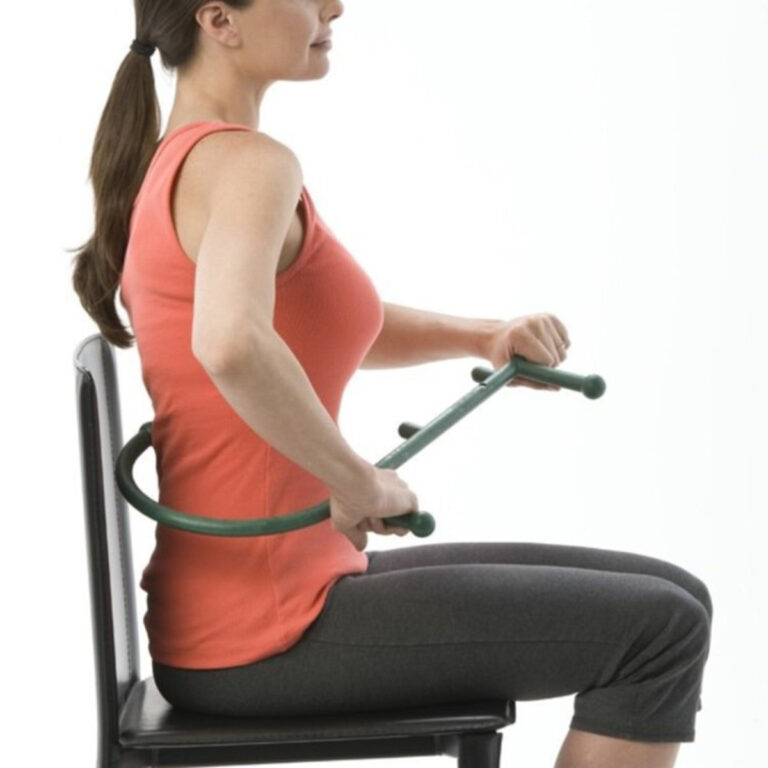
Shop the Thera Cane through Compass’s Amazon link
You can also visit our Compass Amazon Store or explore our additional Thera Cane demonstration videos.
Schedule an assessment if shoulder pain keeps returning, limits everyday movement, or is not improving. Sudden severe pain, inability to move the arm, persistent numbness, or pain after an injury needs prompt medical attention. Shoulder or arm pain with chest pressure or shortness of breath needs emergency care. See guidance on when to seek help for shoulder pain.
At Compass Chiropractic and Massage in Indianapolis, we can assess your shoulder movement and discuss whether hands-on care, rehabilitation, or another evaluation is appropriate.
Contact Compass Chiropractic and Massage to arrange an appointment, or call 317-257-2800.
If you’ve heard about dry needling, you might wonder: How can such a small needle make a difference in a painful muscle?
Dry needling uses thin, solid needles to stimulate selected muscle tissue. The goal is to reduce pain and help movement feel more comfortable—not simply to put a needle wherever something hurts.
Unlike an injection, dry needling does not deliver medication or fluid. The needle itself provides the stimulation.
Treatment often targets sensitive areas within tight bands of muscle, commonly called trigger points. These areas can be tender when pressed and sometimes contribute to pain felt elsewhere. An examination helps determine whether muscle-related pain is part of your problem. Mayo Clinic Health System
The needle creates a small physical stimulus in the tissue. Researchers are studying several possible effects, including changes in local circulation, muscle activity and the way the nervous system processes pain.
Sometimes a muscle briefly twitches in response. You might feel a quick contraction or deep ache. That response is different from an intentional muscle contraction during exercise.
A helpful way to understand the treatment is this: dry needling provides stimulation that may change how a painful area feels and moves. It is not a mechanical process of cutting out or removing a “knot.” Cleveland Clinic
No. Some people notice less discomfort or easier movement, while others experience little benefit.
Research findings vary by condition, technique and comparison treatment. A 2026 review found that many reviews reported benefits, but limitations in study quality and consistency prevented firm conclusions about overall effectiveness. Dry needling should be considered an option—not a guaranteed solution. Research review
Feeling better is useful. Being able to do more is the bigger goal.
Dry needling is commonly combined with exercise and other rehabilitation approaches. If it makes movement more comfortable, that may create an opportunity to work on strength, mobility and tolerance for everyday activities.
The needles do not replace the work of rebuilding those abilities. Your exercise homework and activity recommendations remain important parts of the plan. Mayo Clinic Health System
Dry needling should begin with a health-history review, examination and discussion of benefits, alternatives and risks. Tell your provider about medications, pregnancy, recent surgery and relevant health conditions.
Temporary soreness, bruising or minor bleeding can occur. Less common complications include infection or injury to deeper structures. Needling near the chest carries a risk of a collapsed lung; new chest pain or difficulty breathing after treatment requires urgent medical attention. Treatment should be performed by an appropriately qualified clinician using sterile, single-use needles. Cleveland Clinic
At Compass Chiropractic, the conversation starts with your symptoms and the activities you want to return to—not with choosing a treatment first.
Ask us whether dry needling could fit your care plan and how we would evaluate your response.
Our goal is to help you MOVE BETTER, so you can FEEL BETTER, and ultimately LIVE BETTER.
It can take a little planning to keep moving when the days get shorter. A summer evening walk fits naturally between dinner and sunset, but by fall that time slot may be dark, chilly, or filled with other commitments. If your activity routine has slipped, the old schedule may simply need an update.
You do not need to recreate summer indoors or begin an ambitious fitness program. Start by finding a few opportunities that fit the week you actually have.
Think about what changed when the days got shorter. If daylight was your cue to go outside, choose another cue: lunch, the end of the workday, or finishing the school drop-off.
Make the first version small enough to repeat. For example, put a ten-minute walk after lunch on your calendar for three days this week. Treat that as a starting habit, not a complete exercise prescription.
Write down the practical details too. Where will you walk? What shoes will you use? What is your backup if it rains? A specific plan leaves fewer decisions for a busy afternoon.
CDC guidance for adults recommends at least 150 minutes of moderate-intensity aerobic activity each week, plus muscle-strengthening activity on at least two days. Activity can be divided into smaller amounts, and some movement is better than none.
That is a longer-term target to adapt to your health and ability, not a requirement to meet immediately. Build gradually if you have been less active. At a moderate walking pace, you can generally talk but would find singing difficult.
Plan an alternative before the evening you need it. Depending on your space, interests, and health, that might be walking indoors, dancing to a few songs, using a stationary bike, or following a familiar exercise routine.
Pick something with little setup. Clear a safe area, have the equipment you need ready, and choose the activity in advance. A routine that takes ten minutes to prepare may be harder to use when you only have fifteen minutes available.
For an outdoor walk around Broad Ripple or your neighborhood, choose a route with lighting and secure footing. Wet leaves, uneven sidewalks, and poor visibility may be reasons to change the route or move inside.
Walking is useful, but it is not the only type of activity to consider. A strength routine can use body weight, resistance bands, or weights, depending on your experience and needs. The right starting point should let you move with control.
If you are unsure what to choose, ask for guidance before copying a challenging online routine. You can write “strength practice” into the schedule first and work with a clinician or qualified exercise professional to decide what belongs in that session.
Older adults should also include activities that work on balance as appropriate. Choose a safe setting and support when needed; feeling unsteady is a reason to adapt the activity.
Here is an example of how to organize a starting habit. It is not intended to meet every weekly activity recommendation:
At the end of the week, ask what was easy to repeat and what got in the way. Build from the parts that worked instead of treating a missed day as a failed plan.
Modify activity that aggravates symptoms and seek advice for pain that persists, worsens, or repeatedly limits your routine. Stop exercising and seek urgent help for chest pain, fainting, or severe unexpected breathlessness. People with chronic conditions or activity restrictions may need an individualized plan.
For a related look at walking, read Walking and Back Pain: What New Research Means for You.
If back, neck, or joint discomfort is making it difficult to keep moving, contact Compass Chiropractic and Massage in Broad Ripple. Tell us what you would like to get back to doing, and we can discuss an appropriate next step.
The temperature drops, you reach for a jacket, and your knee or back seems to notice before you do. What does research tell us about cold weather and joint pain, and does a chilly day really explain a new ache?
Many people describe that pattern. Research offers a less tidy answer: some studies find relationships between weather and pain, while others do not. Cold weather alone does not explain every flare-up, and a sore joint cannot tell you what is happening inside it.
A 2023 review of 14 observational studies found associations between weather conditions and osteoarthritis pain, including an association between lower temperatures and more pain. The studies varied, and an association does not establish that temperature caused a person's symptoms.
A different review published in 2024 examined case-crossover studies, which compare weather around pain events with control periods in the same people. Its pooled analyses did not find associations between temperature, humidity, air pressure, or precipitation and the risk of rheumatoid arthritis pain events, knee pain, or low-back pain.
Those studies ask somewhat different questions and include different conditions and methods. They do not support a blanket claim that cold weather causes pain in everyone.
In the 2019 “Cloudy with a Chance of Pain” study, an analysis of 2,658 people living with chronic pain found modest associations with humidity, wind, and atmospheric pressure. Temperature itself was not significantly associated with pain. That is another reason to distinguish “the weather” from cold alone.
If you notice more discomfort on chilly days, that experience is worth discussing. The research does not let us predict how one particular person will feel tomorrow.
It also does not tell you whether a new ache is arthritis, a muscle problem, or something else. Stories about joints expanding or joint fluid thickening are often presented as settled explanations; the clinical evidence is not that simple.
When a seasonal pattern appears, look at the rest of the day too. Did you skip your usual walk, spend longer sitting, tackle an unfamiliar chore, or sleep poorly? These are useful details to record, not proof of a cause.
Choose a few practical habits that do not depend on predicting the weather perfectly:
For people with osteoarthritis, NIAMS guidance includes appropriate exercise and, for some symptoms, heat or cold as management options. Ask your clinician what suits your condition, particularly if you have reduced sensation or circulation problems. Protect your skin when using heat or cold.
A new hot, red, swollen joint, especially with fever, warrants prompt medical evaluation. So does an inability to bear weight after an injury. Persistent or worsening pain should be assessed rather than repeatedly attributed to the season.
Bring a short record of what hurts, when it happens, and which activities change it. That information can help make the next step more specific.
If discomfort is getting in the way of your daily activities, contact Compass Chiropractic and Massage in Indianapolis to discuss an assessment. The aim is to understand your symptoms and help you plan appropriate care.