
Ankylosing Spondylitis is a type of arthritis that typically begins during adolescence or in a person’s early twenties and occurs more often in men than in women. However, once experiences onset, they are affected for the rest of their lives. It is estimated that between 0.2% and 0.5% of individuals in the United States suffers from ankylosing spondylitis. It can cause significant pain, discomfort, and immobility. While there is no cure for the condition, the symptoms can be treated, bringing some degree of comfort and mobility.
Ankylosing Spondylitis, or AS, is a type of arthritis that causes inflammation in the spine. While the vertebrae are primarily involved, it can also affect other joints as well, including the hips, shoulders, heels, ribs, and the small joints of the feet and hands.
In some cases, the heart, lungs, and even eyes can be involved. If left untreated, the condition can progress, causing chronic pain that can be severe as the spinal inflammation increases. More advanced cases can cause the spine to grow new bone formations so that it is immobile, or fixed, sometimes resulting in kyphosis, which is a bowed or forward stooped posture.
While genetics is believed to be a key player in the development of Ankylosing Spondylitis, the exact cause has not yet been determined. The majority of people who have AS also carry a specific gene that has been linked to the condition.
This gene produces HLA-B27, a protein or genetic marker, that more than 95% of Caucasians with ankylosing spondylitis have. However, there are people who don’t have this protein who develop AS and there are many people who do carry this marker yet never develop the condition.
Researchers theorize that there may be other genes that may be involved, as well as environmental factors that trigger the gene activation, such as a bacterial infection, causing people who are susceptible to AS to activate it. Scientists have identified more than 60 genes that are believed to be associated with AS with only about 30% that are linked to HLA-B27 regarding overall risk. Other genes that have been identified as key to AS include IL-23, IL-17, IL-12, and ERAP.
It is also believed that AS can be triggered when the intestinal defenses break down, allowing certain bacteria into the bloodstream. This can, in turn, cause an immune response.

AS cannot be cured, but the symptoms can be treated to relieve stiffness and pain as well as delay or prevent spinal deformity and other complications. The damage that it does to the joints is irreversible, so it is best if treatment is started before that occurs. There are several ways that AS is treated:
Chiropractors strongly recommend chiropractic treatment for the non-acute inflammatory stage of AS. Once the condition has progressed to acute joint disease, there is a very high risk of injury or damage to the connective tissue. Adjustments and exercise are used to relieve symptoms, but some of the traditional spinal manipulation treatments are not performed.
A chiropractor will also make recommendations to the patient regarding lifestyle changes that can help with symptoms, such as stopping smoking. Tobacco use can increase inflammation and damage connective tissue. They may also advise increasing their intake of omega 3 fatty acids in their diet. Regular chiropractic care can help patients manage symptoms and prevent disease progression, improving their quality of life.
Do you have ankylosing spondylitis? Come see us to get evaluated soon.
People often describe sharp rib or upper-back pain as a “dislocated rib” or a “rib out of place.” Possible symptoms include localized tenderness, pain with a deep breath, discomfort when twisting or coughing, and a clicking or popping sensation. However, those symptoms do not prove that a rib is dislocated.
Rib and chest-wall pain can come from several different conditions, including a muscle strain, irritated rib joint, bruised or fractured rib, costochondritis, or slipping rib syndrome. Because chest pain can also come from the heart, lungs and other organs, an examination is important—especially after trauma or when breathing is affected.
The ribs attach to the spine in the back and, for most ribs, to cartilage near the breastbone in front. A true traumatic joint dislocation is not the only explanation for pain around these attachments. In everyday conversation, “rib out” is often used as a general description for painful or restricted movement in the rib and thoracic region.
Slipping rib syndrome is a specific but uncommon condition involving excessive movement of the cartilage of the lower “false” ribs, usually ribs 8 through 10. It may cause intermittent lower chest or upper abdominal pain and sometimes a clicking or slipping sensation. It is different from a rib fracture and from general upper-back stiffness.
Symptoms that may accompany a musculoskeletal rib or chest-wall problem include:
These symptoms overlap with fractures, muscle injuries, cartilage irritation and other conditions. A lump, visible deformity, significant bruising or severe pain after an impact requires medical evaluation rather than an attempt to manipulate the area.
Car accidents, falls and contact sports can bruise or fracture a rib and may also injure the surrounding muscles, cartilage or internal organs. Rib tenderness after a significant impact should be assessed, particularly if breathing is painful or difficult.
Forceful, prolonged coughing can strain the muscles between the ribs and, in some cases, contribute to a rib fracture. Repetitive rotation in sports such as golf or rowing can also irritate the chest wall.
Lifting, reaching, throwing or an unfamiliar workout can irritate the intercostal muscles or joints where the ribs meet the spine. Pain may be reproducible with movement or pressure, but that finding alone does not rule out other causes.
With slipping rib syndrome, hypermobile lower rib cartilage can irritate an intercostal nerve. Symptoms can be intermittent and may be triggered by certain movements. Diagnosis is clinical, and dynamic ultrasound is sometimes used when the diagnosis is uncertain.
Costochondritis, lung conditions, digestive problems, shingles and heart-related conditions can all cause pain in or near the ribs. New or unexplained chest pain should not be self-diagnosed as a rib problem.
Call 911 for sudden pressure, squeezing or crushing chest pain; pain spreading to the arm, jaw, shoulder or back; severe shortness of breath; fainting; heavy sweating; or chest pain with nausea or dizziness.
Seek prompt medical evaluation for:
An evaluation starts with how the symptoms began, their exact location, breathing symptoms and any recent injury or illness. The clinician may examine the ribs, chest wall, spine, shoulder and breathing pattern. Imaging or referral may be appropriate when a fracture, lung injury, slipping rib syndrome or another medical cause is suspected.
Do not try to have a painful rib forcefully “popped back into place,” particularly after trauma. Treatment should match the diagnosis.
A bruised or fractured rib, slipping rib syndrome, muscle strain and irritated thoracic joint require different management. Depending on the findings, care may include activity modification, pain management, breathing guidance, gradual mobility work, rehabilitation or medical referral.
When serious causes and fracture have been ruled out and the problem is musculoskeletal, conservative care may help restore comfortable movement and reduce surrounding muscle tension. Chiropractic or manual treatment should be selected carefully and should not be presented as a universal way to reposition every painful rib.
If your symptoms followed a collision, visit our Indianapolis auto-accident care page. For a sports-related problem, learn about our sports injury services.
Concerned about persistent rib or upper-back pain? Request an evaluation at Compass Chiropractic and Massage.
This information is educational and does not replace medical diagnosis or emergency care.
Throbbing, dull and achy, sharp and excruciating. All of these words can be used to describe lower back pain.
Unfortunately, lower back pain is a common occurrence in adults. According to the American Chiropractic Association, low back pain is the single leading cause of disability worldwide, with millions of reported cases every year.
What treatment should you seek if you experience pain in your lower back? The good news is that it often heals on its own. A few days of over-the-counter pain meds, ice, and taking it easy, and you could be back to normal.
However, those who continue to deal with the pain after a few weeks' time may choose to look for other solutions. This is also true for people who experience repeated flare ups, or chronic lower back pain.
One of the best and most popular options is chiropractic care.
Why?
First of all, chiropractic care doesn't focus solely on the pain, but helps the body heal itself. Chiropractors understand the bones, muscles, discs, and nerves in the back, and are able to figure out the reason for the pain.
From there, they can create a customized treatment plan from compresses to spinal manipulation to exercises that helps heal the area and reduces the pain.

Because of its healing, restorative approach, chiropractic treatment tends to the source of the pain, instead of simply dulling it. Spine Universe estimates 6 to 12 treatments are typically needed to treat low back pain, but each individual person's requirement may vary.
Over the course of these treatments, spinal alignment begins to balance the other parts of a person's back and helps correct the issue causing the pain. In addition, spinal manipulation helps improve mobility and function in many cases, whereas drugs alone do not.
Finally, chiropractic care for lower back pain also help minimize relapses.
Patients who experience lower back pain obviously never want to deal with it again, but it can flare up periodically. According to the National Institute of Neurological Disorders and Stroke, roughly 20% of those who suffer from low back pain will eventually deal with it chronically. This can cause frustration, especially when it affects mobility.
Before you run screaming in horror to the medicine cabinet, one of the best reasons to participate in chiropractic treatment is that it helps reduce the chance of a recurrence. By working on the total body and getting it in the best shape possible, the patient is stronger and more balanced to handle their workload and other strenuous activities. Chiropractors also impart advice on how to minimize the chances of re-aggravating the lower back.
Millions of people suffer with back pain each year, and some never visit a chiropractor. Those who do choose chiropractic treatment are privy to treatment that reduces their pain, increases healing, shortens their downtime, and lessens their chances of a recurrence. If over the counter medication and ice packs haven't worked within a few days, it's time to make an appointment for a consultation with a licensed chiropractor. You will be happy you did.
If you are considering going upright in your workplace or workspace, you are not alone. Companies large and small are recognizing the benefits of this healthy, spine friendly way of working and they are incorporating it into their employees’ work stations. It places the body in an optimal position, between standing and sitting to provide an ergonomic solution to working at a desk that saves space too. Even home offices are getting in on the movement. These case studies tell the stories of four companies that incorporated upright workspace technology for their own organizations.
Rhode Island based start-up company, ShapeUp, is a health and technology centered small business with just employees. It manages the design and implementation of socially activated wellness programs in the workplace. They were looking for furniture that was high quality and tough enough to withstand a workforce that was very active. At the same time, it needed to promote good heath to remain consistent with the company’s health oriented ideals.
Their first step moving in that direction was to purchase several community upright workstations. This would allow employees to get upright at various points during the day. The feedback from employees was so positive that upright workstations were placed in each employee’s work area. They reported reduced back pain and increased energy, attributing it to the simple act of going upright.
FLUX, based in San Francisco, is a small tech company with fewer than 50 employees. The venture backed start-up created software that “reimagines sustainable building design.”
In 2012, Nicholas Chim, the company’s founder, began searching for body friendly workstations that would help keep his energy level up and help him maintain his focus. He purchased an upright station for himself to keep in his work area. Many of the employees expressed great interest in this strange, new workstation. Once, Chim came home from a business trip and found that one of the employees had taken over his upright station.
It was then that Chim realized he needed to purchase upright stations for all of his employees if he was going to keep them happy and healthy. He now offers upright work stations to all of his employees; all they have to do is request it.

Katie Rowe Mitchell has a home office where she runs her start-up, Unfold Yoga + Wellness with her friend and partner Nicole Elipas Doherty. The company brings meditation practices and accessible yoga to organizations as a wellness measure for the companies’ employees. She left her long time corporate job that left her feeling physically uncomfortable, overstressed, and overworked due, in part, to her sedentary work style.
She recognized the link between yoga and having more energy and better focus so she left her corporate job to start her own company that would bring yoga to stressed out workers. In her own home office, Katie wanted a more active work style and an upright work station was the answer. It keeps her engaged in mind, body, and spirit. She has a newfound sense of freedom that sitting behind a desk for hours every day did not provide. Going upright opened a whole new world for Katie.
Tech non-profit Wikimedia Foundation is based in San Francisco and has 200 employees. It powers several collaboratively edited projects including Wikimedia. When the company decided to redesign their office space, they decided that they wanted to create a work environment that empowered and encouraged employees to work together. They chose a dynamic environment with an open floorplan – and they included several upright stations. These workstations were grouped together so that all of the employees would have an opportunity to use the stations at different times. The upright desks also proved to be space saving and took up less room in the work area than traditional desks and chairs.
Have you made the switch to an upright desk? Are you experiencing more back pain because of it? Come see us to get evaluated and make sure an upright desk is right for you.
Fitness trackers and wearables have been in the news lately for their ability to pick up data points that could predict a COVID-19 infection. It is speculated that these fitness tracers could predict a COVID infection by tracking parameters such as respiration rate and daily step count. It is estimated that 21% of all Americans wear a fitness tracker and an estimated 25 million of these devices where sold in 2019. With so many Americans wearing fitness trackers, they could play a vital role in helping us catch COVID infections earlier and possibility prevent future spread of the virus.
One such wearable, the Whoop strap, has claimed that they can predict a COVID infection two days prior to developing symptoms. I have been using the Whoop strap since September 2020 and I have enjoyed the insights that I have gleaned from it's (sometimes overwhelming) extensive weekly and monthly reports. One of the data points that I use daily is the Recovery Score. Whoop generates a daily Recovery Score using 4 metrics; Heart Rate Variability (HRV), Resting Heart Rate (RHR), Sleep and Respiratory Rate (# of breaths/minute). Based on your recovery score, Whoop creates your recommended daily Strain which is a numerical value that represents how hard you should push yourself during exercise.
On January 2nd, I got on my bike trainer and picked a 1.5 hour workout. When I reached the 20 minute mark I knew I wasn't going to finish the ride. I never felt short of breath, but I had very little stamina. I pushed to 30 minutes and decided to call it, which is unusual. That evening I started to feel fatigued and I started to experience a headache behind my eyes. That night was miserable and the next morning when I checked my Recovery score I was shocked to see that it was 1%. Even at my most fatigued, I had never seen a score close to 1%.
Could I have seen this coming based on my Whoop data? Let's look at my Recovery Score for the two days prior to the start of my symptoms. It is important to remember that the data from the Recovery Score represents the tracking from the night before.
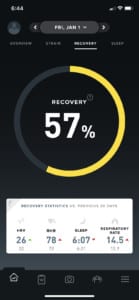
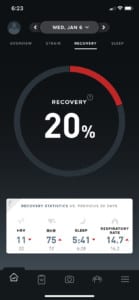
Recovery Score from the Night of 12/31

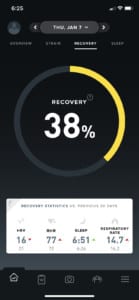
Recovery Score for the night of 1/1
What do these Recovery Scores tell us?
First Whoop color codes the Recovery Score; Yellow represents moderate recovery and Green represent significant recovery. Both yellow and green recovery scores allow for an increased level of Strain (exertion) for the day. I would typically be happy with either one of these Recovery Scores and see this as a sign that I have recovered well. What I didn't notice in these scores was an increase in Resting Heart Rate and increased Respiratory Rate. While I have seen my Resting Heart Rate close to these levels (typically related to alcohol consumption), these are the highest Respiratory Rates that I have seen since I started using Whoop. I don't know how much weight Whoop gives to each data point, but it seems that Heart Rate Variability is weighted higher than the other data points when generating the Recovery Score.
The next two days day- January 3rd and 4th
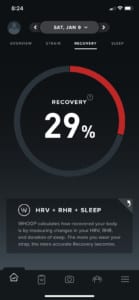
As I mentioned, the night of the 2nd was miserable so I decided to get tested in the afternoon of the 3rd which came back positive. The night of the 3rd was equally miserable. Here are the Recovery Scores from those days.
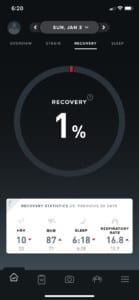
Night of the 2nd
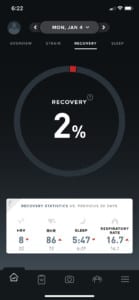
Night of the 3rd
My Respiratory Rate has averaged around 13 and now was almost 17. I never paid much attention to the Respiratory Score because it has been consistent with only small fluctuations.
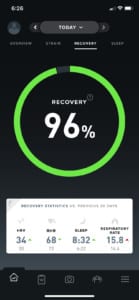
On the third day I began to feel better and headache finally eased. The fourth day came with an ear ache that lasted a couple days. Today my Recovery Score was a 96% and I can say that I am feeling significantly better. While I never felt like I had trouble breathing, my Respiratory Rate did indicate that I was taking more breaths per minute than I had previously. Even though my score today was a 96%, my Respiratory Rate has not returned to my norm.
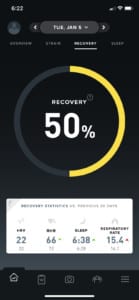
In hindsight I would say that my Whoop strap gave me the data that showed that there was a potential COVID infection brewing, but without a COVID test prior to Jan 3rd it is hard to know for certain if I was infected. Had I put more stock in the Whoop data I might've detected a COVID infection prior to the onset of symptoms but that is pure speculation.
COVID is obviously on the top of everyones brain, but when we get past this pandemic how can we use this data? These data points might be able to tell us when our bodies are not at an optimal place and remind us to listen to our bodies and give it a chance to recover in order to stay healthy. If these wearables can tip us off to small inconceivable changes in our body that can negatively affect our health, we might learn to notice these changes without the aid of a wearable.
New Year’s Resolutions made by well-meaning but, unfortunately, less than 10 percent of people who make resolutions feel that they successfully achieve them and only 45 percent last past six months. Self-improvement goals like lose weight, eat healthier, quit smoking, and life improvement rank in the top five more popular resolutions. So, what is that 10 percent doing that makes them successful at achieving their goals? What sets them apart?
The SMART approach is a guide for setting realistic goals and attaining them. It is an acronym that outlines a success focused strategy for goal setting:
Each step will bring you closer to achieving your goals and improve your health.
Vague, ambiguous goals can’t stand up to time and temptation. Get specific.
Say you want to lose weight. How much do you want to lose? How do you plan to accomplish it? What are your reasons for setting this goal? Whatever goal you are setting, ask why and get specific about the details.
If you set a goal that you can’t measure, how will you know when you reach it?
Any goal that you have can be measured in some way. Weight loss is measured in pounds, how your clothes fit, or how many inches you’ve lost. Eating healthy can be measured by what foods you incorporate into your dies, getting the junk food out of your pantry, and finding healthy recipes.
It helps to break your main goal into several smaller, attainable ones. It lets you see success very early and you keep seeing success which spurs your motivation, making you less likely to abandon your efforts.
Accountability is a great motivator for helping you stick to your goals. Keeping a journal has long been a great way to keep yourself accountable, but there are many website and software programs that you can use to track your efforts that may prove to be even more effective.
Partnering up with a buddy is also a great strategy. Choosing someone who has a goal similar to yours allows you to hold each other accountable. Plus, success is always better when you can share it with a friend.
Unrealistic or unattainable goals are motivation killers. Even goals that are too difficult or require high pressure effort over a long period of time can be difficult to stick to.
As you sit down to set your goals, think about not only what you want to achieve, but what that looks like in your life. In other words, consider your personality and lifestyle, structuring your goals to accommodate those factors.
If your goal is to lose weight, setting a goal of 30 pounds in 30 days is not only unrealistic, but unhealthy. On the other hand, setting a 2 pound per week loss is a goal that you will likely find to be much easier.
Creating a timeframe for meeting your goals gives your efforts structure which helps to keep you motivated. Make sure your timeframes are realistic; give yourself enough time.
If the constraints are too tight you could find that you veer off the path and even lose sight of your goals. Stay flexible, though. If you don’t reach a goal within a given timeframe, don’t be afraid to move it a little.
As long as you are moving forward, toward your goal you don’t need to limit yourself just because you didn’t complete it within the time you originally allotted. It’s about meeting your goals and making lasting changes that will affect your overall health for the better. Cut yourself some slack.
Another way to accomplish you exercise health goals is to practice Incidental exercise.
Your spine goes through a lot each day. It provides structural support and houses the central nervous system which carries impulses from the brain throughout the body. When it isn’t working as it should, the entire body can be affected. Chiropractic has long been praised as a way to keep the back healthy. Well, now we’ll get down to the nitty gritty and examine just why it is so good for your spine.
Posture is not only good for your spine, it is beneficial for the entire body. It keeps the body in proper alignment which, in turn, allows the muscles to work as they should.
This prevents abnormal wearing on the surfaces of the joints and allows joint and muscles to work more effectively and efficiently. Good posture helps to prevent injury and even helps with proper organ function.
However, many people have poor posture and don’t even realize it. Chiropractic can help bring the body into alignment and improving posture which greatly benefits the spine. The patient then enjoys improved range of motion and even more energy as the body does not have to work so hard to compensate for misalignments and poor posture.
It is estimated that as much as 90 percent of people experience back pain at some point. Considering all that the back goes through in a typical day, it isn’t much of a stretch to think that there might be some pain involved at times. This is especially true if the back is not properly aligned.
Chiropractic is traditionally thought of as a treatment for back pain, but what many people don’t realize is that it is also used to treat pain in the knees, ankles, feet, hands, and jaw. When there is pain in the body it will often try to compensate by adjusting to take the pressure off of certain areas.
This can cause misalignment which can impact the entire system, causing pain and stiffness. A Doctor of Chiropractic may treat these problems with various chiropractic techniques, specific exercise recommendations, and even dietary changes in order to relieve the pain.
The spine is the primary support for the body. When it breaks down, the body suffers. Regular chiropractic treatment ensures that the spine remains in proper alignment which, in turn, keeps the body in proper alignment.
It helps with joint health as well as the health of the related muscles and ligaments. Your chiropractor can also recommend stretching and strength building exercises to help keep your spine strong and supple.
Chiropractic helps to keep the back flexible which aids in preventing injury. A strong spine is also less likely to become misaligned or experience pain. This can greatly improve your quality of life as you are more flexible and mobile.
Chiropractic is good for your spine which means it is good for your overall health. While many people think that its only purpose is to treat back pain, chiropractic actually focuses on total body wellness.
All too often problems within the body are interrelated. For instance, back pain could be the result of an altered gait due to an ankle injury, or a headache could be caused by a misaligned neck due to improper sleep positions (or even the wrong pillow).
Chiropractors do treat the symptoms but they also delve into the problem to discover the root so that true healing can occur. This not only makes the spine healthy, but the entire body as well.
Chiropractic care is a respected, effective treatment for a variety of conditions as well as for promoting overall wellness. Every day patients seek it out manage their pain, find relief from health issues, and recover from injuries.
What many may not realize is that an estimated 90 percent of top athletes use chiropractic to step up their game. You don’t have to be an athlete to step up your own game with chiropractic care. Here are three benefits that the pros enjoy – and you can too!
Chiropractic has long been regarded as a natural, non-invasive, drug free approach to pain management. Numerous studies have proven its effectiveness in treating pain for a number of conditions and injuries. Many pro athletes utilize this option to manage their own pain from over taxed muscles and ligaments to activity related injuries.
When the spine not properly aligned it can put pressure or stress on other areas of the body. Spinal adjustments can help relieve pain in ligaments, joints, discs, and muscles. However, chiropractic techniques can be used on all parts of the body, including arms, hands, fingers, feet, hips, and knees.
Doctors of Chiropractic understand that when it comes to treatment, there is not a one size fits all option. Every patient is different and they will tailor a custom plan that benefits the entire body based on lifestyle, activity level, age, health conditions, and other factors.
The first appointment will include a variety of evaluations that help the doctor determine the best course of treatment for you, including the activities you engage in and the frequency. This way he or she can get an idea of your risk of injury and the areas to concentrate on in your treatment. So, whether you are a pro football player or a weekend warrior, chiropractic can definitely improve your performance and help protect you from injury.
For pro athletes, injuries are just part of the game. High impact sports like hockey, football, and wrestling tend to result in injuries, but even non-contact sports like baseball, cycling, and golf can lead to injuries as well.
Low impact as well as low impact athletes find great value in routine adjustments and spinal alignments. This alone helps to lower their risk of injury as well as improve flexibility and enhance performance. It can help reduce the stress and strain that all types of physical activity places on the body, whether you are a pro golfer or football player, or if you enjoy working in your garden or are a stay at home mom running after kids all day.
Some of the top names in pro sports rely on chiropractic to treat injuries, manage pain, and enhance athletic performance. You might recognize some of the names: Barry Bonds, Arnold Schwarzenegger, Lance Armstrong, Evander Holyfield, Tiger Woods, Joe Montana, and Martina Navratilova are just a few. You don’t have to be an athlete, though, to reap the same benefits that the pros do. You can get them by scheduling an appointment with a chiropractor.
Chiropractic care is a safe, effective healthcare option that is appropriate for all ages and activity levels. Your Doctor of Chiropractic will sit down with you and work with you to create a treatment plan that is tailored to meet your unique needs.
Because this type of treatment focuses on the root of the problem instead of just managing symptoms, your own treatment plan will usually involve not only adjustments and chiropractic techniques, but dietary recommendations, exercises, and lifestyle modifications as well so that you enjoy whole body wellness.
Most people don’t even think about visiting a chiropractor until they’ve sustained an injury or need a quick adjustment to help ease pain. They typically see it as a treatment for injuries or conditions that they’ve already sustained, not as a preventative health care option. And while chiropractic care is an exceptional way to treat existing conditions and injuries, that is only half of the picture. It is also a viable health care approach that is effective in improving overall wellness. There are some very compelling reasons to incorporate chiropractic into your everyday life. Chiropractic can:
When the spine is out of alignment it can put stress on other parts of the body including ligaments and joints. Regular chiropractic care helps keep the spine aligned thus reducing your risk of injury.
Chiropractic treatment can help to balance your hormones. It increases the feel-good hormone dopamine while decreasing the stress hormone cortisol. This makes it an exceptional drug free option for patients who suffer with anxiety, depression, or mood swings. As part of your treatment you chiropractor may also recommend dietary and lifestyle changes that can help even more.
When your spine is out of alignment your entire body suffers. You can feel stiff, sore, and fatigues. Most patients report feeling invigorated after their treatment. They can move easier and have much more energy. Part of this is due to the effect the treatment has on the body as well as the hormones that are released that provide a boost in your mood.
More than 60 percent of people in the United States, both children and adults, report having problems with sleep. Studies show that chiropractic can actually help with insomnia allowing you to get better, more restful, and more beneficial sleep.
The combination of pain alleviation, increased flexibility, and overall wellness as well as stress relieving properties allow your body and mind to relax so that you can fall asleep easier and stay asleep. Incorporating chiropractic care into your everyday routine can help you get a better night’s sleep.
Studies show that patients who receive regular chiropractic care have a significantly stronger immune system than patients who don’t see a chiropractor. In fact, one of the most significant studies to date that explored the connection between regular chiropractic care and a strong immune system was conducted by Dr. Ronald Pero, Ph. D. of New York’s Preventive Medicine Institute where he was the chief of cancer research. He was also a professor of medicine at New York University. The study, which spanned several years, found that patients who received chiropractic care on a regular basis had a 200 percent greater immune competence than non-chiropractic patients.
Chronic pain as well as pain from injuries or certain conditions respond very well to regular chiropractic care. Any type of pain can negatively impact your quality of life, but pain medications can have unpleasant side effects that can be debilitating. It doesn’t help that many pain medications are highly addictive.
Chiropractic treatments offer a natural remedy for pain that is medication free. What’s more, regular treatments work to fix the cause of the problem so that the issue can be permanently resolved.
Chiropractic treatments are non-invasive and drug free. It uses the body’s own healing properties to naturally address issues and achieve results. It is low risk and very effective, treating the cause of problems, not just the symptoms the way pain medication does.
When you look at all of the benefits of regular chiropractic care and realize that those results can be achieved naturally, it’s easy to see why more people are incorporating it into their regular health care routines.
Everyone knows that exercise is great for overall wellness, better health, and a strong body. Many chiropractors will often recommend regular exercise to their patients who need to lose weight, want better mobility, or are seeking relief from depression. A number of chiropractors are turning to Pilates to help their patients get stronger, more flexible, and more mobile.
In the early 20th century Joseph Pilates developed the exercise program to help World War I soldiers improve their physical fitness. It was used to rehabilitate patients who had been injured. By incorporating resistance, stretching, and target strengthening exercise, Pilates uses resistance bands, special machines, and floor work to reshape and rehabilitate the body. Dancers, gymnasts, athletes, and celebrities use Pilates to stay in shape. However, anyone can do it for a healthier, more supple spine.
Care of the spine is at the core of Pilates. By keeping it in a neutral, or natural, position, this exercise can prevent back pain as well as help ease it. When done correctly, Pilates can:
The benefits of Pilates tremendous, but for chiropractic patients it is even more so. By regularly incorporating Pilates into your exercise routine, you can enjoy these incredible benefits.
You can adapt Pilates to your fitness level and needs. Whether you are just starting a fitness program or you’ve been working out for years, Pilates can be adapted to your fitness needs and level.
It helps you strengthen your core. The deep muscles of your abdomen, back, and pelvic floor make up the core muscles of your body. Many of the Pilates movements focus on these muscles, making a body that is strong and the frame is supported.
Allows you to strengthen your muscles without bulking up. With Pilates your muscles get strong, but it also stretches the muscles so that they are lean and long. You will look toned and tight but not bulky and muscular.

It helps to improve your posture. Pilates strengthens your body and helps to keep your spine in proper alignment due to a strong core. As a result, your posture naturally improves. By incorporating it into your exercise routine, you will find yourself standing taller, stronger, and more graceful.
You can become more connected through your mind and body by increased awareness. Pilates engages your mind and increases body awareness. It unites mind, body, and spirit for complete coordination. Each movement is done with complete attention.
It improves your flexibility. Pilates is a gentle but powerful exercise that works to safely stretch the muscles, making them longer, and increasing the range of motion in the joints.
It can protect you from injuries. By strengthening your body, Pilates can help protect you against injury. It conditions your whole body so that your muscles and strength are balanced. This reduces your risk of injury.
You get a natural energy boost. Just like with any exercise, Pilates will give you an energy boost. However, it is increased even more thanks to the focused breathing and increase in circulation stimulating the muscles and spine.
It can help you lose weight and attain a lean, long, strong body. Pilates tones and strengthens the body and if you do it regularly it will reshape you. The body is leaner and more balanced. It also helps you move with more grace and ease.
Are you looking for a chiropractor to supplement your Pilates practice? Come see us soon!