
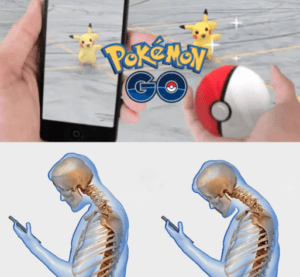
 A few weekends ago we decided to take the family down to the canal to walk around and grab a bite to eat. It didn’t take long to notice that the vast majority of people walking the canal were glued to their phones…more than usual. It dawned on me that most of these people were playing Pokemon Go. As a chiropractor that treats a lot of neck pain, I couldn’t help but think about all the stress that was causing on the neck and upper back.
There has been a lot in the news about the benefits associated with Pokemon Go along with the pitfalls. I see the value in getting people outside and visiting places that they might not if not for the game. My concern is with the strain that is place on the neck when holding it in a forward flexed position for long enough to need an auxiliary battery.
We know that the head weighs about 10-12 pounds and we also know that the weight of your head increases as you look down. The weight of the head can increase to as much as 60lbs depending on how far the head is positioned forward. You can experience this for yourself with this very simple exercise. Take something that weighs about 10-12 pounds (bowling balls aregreat if you have one around) and hold it next to your shoulder with your lower arm straight up. Now move the weight farther our in front of you and you will notice that you immediately start to feel more strain on your arm as the weight moves forward. Imagine doing this for hours as you search for PokeStops around Indianapolis.
As I mentioned earlier, I love that Pokemon Go is getting peoples outside. There are so many wonderful benefits to being outside and I want to promote that as much as possible. What I don’t want to do is promote more strain on the neck and upper back, so we have come up with some stretches that would be helpful if you find yourself purchasing an auxiliary battery for your phone and spending hours searching for PokeBalls.
We would be happy to send you a list of our Tech Neck Stretches if you contact us through our website or our through our facebook page
There are many reasons that you shoulders can get tight. In this post we will look at three reasons that your shoulders might be tight.
When we are in a sitting still we should breath deeply into our belly using our diaphragm. Unfortunately this type of breathing is rare in our stress-filled lives. A more common breathing that you will see around the office is chest and shoulder breathing. This type of breathing relies on the muscles of the neck and shoulders putting excess strain on these muscles. Breathing like this a few times, no big deal but we breathe an estimated 17,000-30,000 times a day. Imagine how sore your arms would be after 17,000 reps! Learn more about breathing in our Compass Chiropractic breathe post.
How often do you find your shoulders up next to your ears? Shoulder hiking is a common response to fear or stress. Think about how a cat arches it’s back when it is frightened. Keeping your shoulders hiked for an extended period of time keeps these muscles active and caused pain and tension over time. One of the muscles (Levator Scapulae) that hikes your shoulders attaches to the top four vertebrae in your neck, which explains how that shoulder tension can lead to headaches. Shoulder hiking is a hard habit to break but it can be done. To break the habit, put a post-it note at your desk with the word “shoulders” on it as a reminder to lower and relax your shoulders. Over time you will teach your shoulders to remain in a relaxed position.
Your head weighs about 12 pounds, about the weight of a bowling ball. This is a lot for your poor neck and shoulders to lug around daily. Imagine holding a bowling ball close into your body, heavy but you can do it. Now extend your arm out in front of you, the ball gets much heavier. The same is true for your head. We know that you head effectively weighs an additional 10 lbs for each inch that it is in front of your shoulder. So lets say you’ve been really focusing on your work and jutting your chin forward three inches. Your head now weighs 42 pounds! Learn how Compass Chiropractic can help you with your posture.
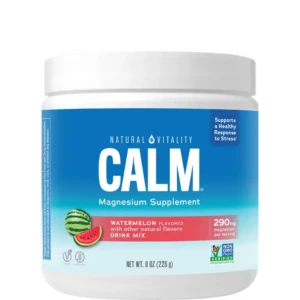
Magnesium is our body's natural muscle relaxer. Being deficient in magnesium is very common and can lead to the body having troubles with relaxing certain muscles.
I'm a big fan of Natural calm which is a powder so you can moderate your dose easier than taking a pill. Also, it is easier to absorb in this format as opposed to a pill. You can purchase this through us, at a local health food store or online.
It is no wonder why your shoulder are always tight and sore. The three reasons that we mentioned above also lead to dysfunctions in the joints of the neck and upper back that perpetuate tension and soreness. At Compass we incorporate a variety of techniques to restore this lost range of motion and eliminate shoulder and neck tension.
If you have questions about how we can help, you can reach us through our contact us page.
By Dr. Drew
Intro:
Breathing is important, very important. That is obvious. But how many of us know how important proper breathing is? Proper breathing is a critical function of good health, as it rids our bodies of carbon dioxide while providing our systems with vital oxygen. The more efficient this process is, the more effective we are at removing toxins, performing physical and mental activities, and reducing stress and pain – yes, PAIN! Normal respiratory mechanics plays a key role in our neuromusculoskeletal system by affecting both posture and spinal stabilization. The primary breathing muscles also function as stabilizers of our skeleton. Therefore, it makes sense that abnormal respiratory mechanics can have detrimental effects on our well-being.
Mechanics:
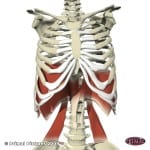 When the proper function of breathing muscles is compromised, the spine is inevitably going to be affected. For example, as the demand for oxygen increases during physical activity, breathing patterns change and spinal stability concedes in order for the body to meet the need for air. We see this all the time when people are exhausted but continue to perform movements or exercises with bad form. The opposite also holds true, as it is very common to find aberrant breathing patterns (e.g. shortness of breath) in people with neck and back pain. Short, rapid breathing can put the body into the “fight or flight” response – an acute reaction to stress. The ability to take slow, deep breaths improves blood flow and returns the body to a calm state.
Assessment:
Renowned authority on manual medicine Dr. Karel Lewit once said, “If breathing is not normalized, no other movement pattern can be.”
Assessing breathing mechanics begins by determining whether you are a belly breather or a chest breather. Belly breathers typically demonstrate proper breathing by utilizing the diaphragm and other breathing muscles 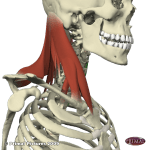 appropriately. Chest breathers, on the other hand, demonstrate faulty breathing by over-relying on accessory (secondary) breathing muscles, such as the upper trapezius and neck scalene muscles. Over time, forward head posture, hypertonic (over-used) trapezius and levator scapulae muscles, shoulder impingement, neck stiffness and increased spinal kyphosis (increased mid-back curvature) can occur if the aberrant patterns aren’t addressed. Other important assessments include rib and lung expansion, checking for symmetry, evaluating breathing rhythms and measuring oxygen saturation. These patterns can be assessed in a variety of positions, which help determine which activities may be contributing to the faulty breathing and/or pain.
At Compass we believe wellness is the fullest expression of health not just the absence of disease. We believe that in order to experience wellness you need to Breathe (properly), Hydrate (well) and Move (often). We are going to be focusing on these wellness topics over the next three months. For the month of February, we are celebrating the importance of breathing by helping our patients recognize abnormal patterns and retraining them. Furthermore, in order to motivate and remind you of the importance of breathing, we have created Breathe Bands which are available at the front desk all month long.
To wrap up our Breathe month, Compass will be participating in the Fight for Air Climb on March 5th.
 Running is one of Americans' favorite forms of exercise. The reasons for its popularity are simple — it can be done almost anywhere, takes no special equipment, and burns lots of calories. Running also offers a great many health benefits such as weight control, decreased blood pressure and cholesterol, and relief from stress.
Everything with running is fabulous, right up until the time you hear a snap, crack, or pop. The downside of all the wonderful benefits is that running causes its share of injuries to the body.
The Ohio State Chiropractic Association presents an alarming statistic that two-thirds of runners will be injured in some way. Tendonitis, shin splints, ankle sprains, hip pain, and knee strains are a few of the many injuries brought on or exacerbated by a regular running routine.
It's important to take common sense precautions to not get injured in the first place. Purchasing high quality shoes and respecting the body's limits are two excellent choices.
Another great choice is committing to chiropractic care. Regular runners can reap many positive results from visiting a chiropractor. Three big benefits chiropractic care offers for runners are the following:
Loose and relaxed joints allow for greater flexibility and movement, all of which benefit a runner's gait and time. A study published in the Journal of Chiropractic Medicine found evidence that a chiropractic treatment regimen increased mobility in the hips over time.
While chiropractic care does not guarantee an individual will experience an increase in speed, unrestricted joints and better range of motion will definitely help a person move more freely and stand a better chance of avoiding running injuries.
Unfortunately, runners frequently deal with injuries, some of which take weeks or months to heal. For dedicated runners, a serious injury is terrible news.
The first action for runners after they have been injured is to stop running so it can heal. Most runners do not want to risk losing the stamina that interrupting their routine brings on.
Chiropractors can work with runners who have injured themselves from the repetitive motion of running regularly. By using chiropractic adjustments, chiropractors can promote healing in the body as a whole. Runners love this because they want to get back to hoofing it as quickly as possible.
A spine out of alignment can cause other parts of the body to be weaker and more susceptible to injury. One part of the body compensating for another that is off kilter is one common way runners end up hurt.
Chiropractic treatment helps to keep the spine in alignment, which can have a ripple effect through the body. Regular adjustments can reduce the negative impact the jarring motion of running has on a person's body, and help avoid running-relating injuries on the front end.
Running is a popular exercise routine for many, and yields a multitude of positive results to a person's health and well-being. By taking proper steps to minimize the chance of injury, runners can enjoy the good points running brings to the table and steer clear of the bad.
Chiropractic care can be an effective part of making certain your body is in prime running condition and resistant to injury. If a person ends up dealing with an injury, chiropractic treatment may be able to boost healing time.
Shoe fit is extremely important for running without injuries - check out our Choosing the Right Running Shoe page.
We don't often think much about how we are running. Are you a heel striker, midfoot striker, do you have a long/short stride, what is your cadence. I can't recommend the 4 Principles of Good Form Running to help you improve your running form and prevent future injuries.
If you are a runner and would like to talk further about the benefits chiropractic care offers you, contact us today for a consultation.
By Dr. Drew Hunt, DC
According to the American Chiropractic Association, 9 out of 10 Americans suffer from headaches. If you are someone who suffers from headaches regularly, you are undoubtedly familiar with the traditional methods used to treat them – ice, rest and popping a pill or two, or three… Even if this or another method works to alleviate the symptoms, you are still not addressing the core causes of headaches and are therefore missing out on permanent relief.
There are a wide range of conditions that can cause headaches, most of which are benign but some may be a sign of a more serious condition. The majority of headaches originate from the muscles, joints and/or nerves of the neck. This group of headaches is referred to as cervicogenic which means “from the neck”. With a common cervicogenic headache, pain is first experienced at the base of the posterior skull and then radiates forward into the temples, eyeballs, and/or forehead.
Typically an increased amount of stress and tension held in the shoulders causes contractions of all the surrounding neck muscles. Combine this with the poor posture that most people exhibit on a daily basis at their work desks and the muscles required to hold your head up can become overworked. When these muscles over-contract, vertebrae can become misaligned and their range of motion restricted causing pressure on spinal nerves, and ultimately pain
Once the nerves are disrupted, pain will result and muscles will contract or “guard”. While it usually manifests as physical pain, this is not always the case. In some instances, the person may experience difficulties with sleep, vision, driving, working or other routine behaviors.
At Compass Chiropractic, we focus on the cause of your headaches by assessing the area(s) of complaint but also looking at environmental factors such as posture, work habits and daily activities. After completing an exam, which may include x-rays, we will then determine if your condition could benefit from our treatment. Most notably are the chiropractic adjustments, which correct spinal misalignments and relieve both pressure and pain. Relief may be experienced immediately and can last for hours to days. However, long-lasting headache relief requires restoring the balance and range of motion to the spine, thus allowing the body to return to a calm state.
We know that many cervicogenic headaches are caused or exacerbated by muscular imbalances of the neck. These muscular imbalances are common in our age of technology and often times perpetuate headache symptoms. We will work with you to create an individualized stretching and exercise program that can alleviate your symptoms and prevent future headaches.
By focusing on the neck dysfunction we are actually addressing the cause of your headache; whereas the medication is merely dulling your perception of it. A report released in 2001 by researchers at Duke University (Duke University study) found that spinal manipulation resulted in almost immediate improvement for headaches originating from the neck, and had significantly fewer side effects and longer-lasting relief of tension-type headaches than a commonly prescribe medication. Combining the adjustments with therapeutic modalities and/or physical therapy over time is designed to eliminate the true cause of the issues behind the headaches.
If you suffer from headaches and are ready for a permanent solution, please give us a call to schedule an appointment today!
The holiday season is upon us which comes with many wonderful things that we can all look forward to experiencing. With the good comes the bad and the bad in this case is travel.
It was estimated that there were over 75,000 people at the Indianapolis Airport the day before Thanksgiving this year! Traveling around the holidays is no fun with long lines, small seats, delays and cancelations. There isn't a lot that we can do in regards to the events that surround holiday travel but there are some steps we can take to prevent aches and pains that make holiday travel much less fun.
The American Chiropractic Association has come up with a quick list of things that you can do to take some of the physical stress out of holiday travel so you can enjoy your holidays without neck and back pain.
Check out the ACA Holiday Travel Tips.
You most certainly do have TMJ, if fact you have two TMJs! TMJ stands for Temporal Manidular Joint, which you have on each side of your jaw. TMJ is often confused with TMJD which is Temporal Manidular Joint Dysfunction.
Temporal Mandibular Joint Dysfunction (TMJD) is a condition that involves the Temporal Mandibular Joints (TMJ) and the muscles of mastication (chewing muscles). TMJD can present as pain, clicking, popping and limited jaw motion. Outside of pain in the jaw, TMJD can also lead to headaches, earaches, dizziness, hearing problems and difficulty swallowing. It is estimated that 20%-30% of the population has TMJD which typical shows up between 20-40 years of age and is more common in women.
There are a number of causes of TMJD some of the causes include muscular imbalances, degeneration of the joint, psychosocial problems, teeth grinding or clenching and occlusal factors (problems with the bite).
How can chiropractic treat TMJD
Chiropractic has been shown to be an effective treatment for people who are suffering from TMJD. IN our office we take a multifaceted approach in treating TMJD.
Many people who suffer from TMJD have excess tension in the TMJ and the muscles associated with chewing. We use manual technique to relieve the tension in the muscles and joints. The goal of this therapy is to improve motion and correct muscular imbalances.
Because of the proximity of the TMJ to the cervical spine (neck), we examine the neck and determine if it is also playing a role in the dysfunction. If we determine that the neck is a contributing factor in the TMJD we will use manual therapies along with stretches and exercises to facilitate proper healing.
Often times there is a stress component to TMJD. In order to treat the stress component we would recommend a stress relief strategy like deep breathing, journaling or nutritional therapy. In our office Magnesium is typically recommended because of its role in stress relief and muscle relaxation. Patients are instructed to take Magnesium prior to sleep in order help relax the muscles of the jaw and prevent clenching during sleep. Patients are also taught ways to ensure that they are not clenching throughout the day and instructed on food and activities that should be avoided.
By Dr. Drew Hunt, DC
Do you suffer from a chronic shoulder pain? Were you told it was a rotator cuff injury? What is a rotator cuff?
Let me begin by answering the last question: the rotator cuff is comprised of four muscles that surround the shoulder joint: Supraspinatus, Infraspinatus, Teres Minor and Subscapularis. The origins of these muscles are found primarily along the scapula (your shoulder blade), along with 9 other muscles! The scapula is what keeps your arm attached to your body and allows fluid motion of your arms away from your body during movements like swinging a golf club, lifting weights and throwing a ball. Together these structures provide support from your arms to your core. Without proper stabilization, the shoulder becomes more susceptible to pain and injury.
Simply put, imbalances in the muscles actually change the axis of motion in the shoulder, decreasing range of motion and function and increasing the likelihood of injury. Terms like “frozen shoulder”, “scapula winging” and “impingement syndrome” are the results of instability around the shoulder joint. Overuse syndrome or “tendinosis” can occur when imbalances cause certain muscles to be overworked while others are left over-utilized. This causes an inability to incorporate proper sensory input to the muscles which in turn further reduces the range of motion.
It is important to understand that shoulder issues don’t necessarily have to occur from one particular instance. In fact, most people with shoulder complaints report no history of trauma or even diagnosis from a doctor. In my experience, patients have convinced themselves that the shoulder “has given out” or “is all screwed up” from age and or athletics. Some patients just give up; others seek help but aren’t being supervised properly. Even those under professional care may be missing the underlying cause of symptoms.
If you have been doing months of rotator cuff strengthening exercises with rubber tubing and you still have shoulder pain, you may need to readdress your treatment protocols. Without a strong base of support to work from, the rotator cuff will never be able to fully recover. The shoulder and arm can only get as strong as the muscles that hold the shoulder blade onto your body.
At Compass Chiropractic, we work with athletes at all levels to assess, diagnosis and treat the kinetic dysfunction in the body, not just the symptoms. In regards to shoulder complaints, techniques such as stretching the posterior shoulder capsule, strengthening the muscles that hold your scapula in place and stretching/relaxing the tight/overused muscles that pull the scapula into a different position have had excellent results. Chiropractic manipulations and soft tissue techniques such as myofascial release, Graston, and kinesiology taping are designed to address these issues on functional, anatomical, and neurological levels.
Compass Chiropractic Earns Esteemed 2014 Angie’s List Super Service Award
Award reflects company’s consistently high level of customer service

Compass Chiropractic has earned the service industry’s coveted Angie’s List Super Service Award, reflecting an exemplary year of service provided to members of the local services marketplace and consumer review site in 2014.
“Only about 5 percent of Chiropractors in Indianapolis have performed so consistently well enough to earn our Super Service Award,” said Angie’s List Founder Angie Hicks. “It’s a really high standard.”
Angie’s List Super Service Award 2014 winners have met strict eligibility requirements, which include an “A” rating in overall grade, recent grade, and review period grade; the company must be in good standing with Angie’s List, pass a background check and abide by Angie’s List operational guidelines.
Service company ratings are updated daily on Angie’s List. Companies are graded on an A through F scale in areas ranging from price to professionalism to punctuality.
Angie's List helps facilitate happy transactions between nearly 3 million consumers nationwide and its collection of highly-rated service providers in 720 categories of service, ranging from home improvement to health care. Built on a foundation of authentic reviews of local service, Angie's List connects consumers directly to its online marketplace of services from member-reviewed providers, and offers unique tools and support designed to improve the local service experience for both consumers and service professionals.
Can a hip problem cause knee pain? Sometimes. The hip, knee, ankle, and foot work together as a movement chain. Limited hip motion, reduced hip strength, or difficulty controlling the thigh during walking, running, stairs, or squatting can increase stress at the knee. Hip conditions can also occasionally refer pain toward the thigh or knee.
That does not mean every painful knee is caused by the hip. Knee pain may come from the kneecap, tendons, ligaments, meniscus, arthritis, a recent injury, or another condition. A useful evaluation examines the painful knee along with the hip, ankle, foot, low back, and the movements that reproduce your symptoms.
This article was updated by the Compass Chiropractic team for clarity and current evidence. The original 2014 article was contributed by Dr. Rick Boatright, D.C.
The thigh bone, or femur, connects the hip joint to the knee. Muscles around the pelvis and hip help control the position of the femur as you stand on one leg, walk, run, jump, or change direction. The knee then has to respond to the forces traveling through that system.
If the hip is weak, stiff, painful, or poorly coordinated, the thigh and knee may move differently during activity. That can be one contributing factor in certain knee conditions, particularly pain around the kneecap and some running-related problems. It is usually one part of a larger picture that can include training load, strength, recovery, footwear, previous injury, and movement habits.
Patellofemoral pain is commonly felt around or behind the kneecap. It may be aggravated by stairs, hills, squats, prolonged sitting, running, or jumping. Hip and thigh strength and coordination are among the factors a clinician may assess.
Iliotibial band syndrome can cause pain along the outside of the knee, often during running or repetitive bending. Hip and core strength, running mechanics, sudden training changes, and recovery can all contribute. The painful area still needs to be examined because several conditions can cause lateral knee pain.
Some hip conditions can be felt in the groin, thigh, buttock, or knee. This is one reason unexplained knee pain—especially when accompanied by hip stiffness, a limp, or groin pain—should include an assessment of the hip.
The hip deserves closer attention when knee symptoms occur with:
These clues are not a diagnosis. They help a clinician decide what to test during an examination.
A thorough assessment starts with how the problem began, the location and behavior of the pain, previous injuries, medical history, and the activities you want to return to. Depending on your symptoms, the examination may include:
The American Physical Therapy Association’s knee pain guidance similarly notes that an examination may include the hip, thigh, ankle, foot, and low back because weakness or limited motion outside the knee can affect knee function.
Treatment depends on the diagnosis and contributing factors. A care plan may include temporarily modifying painful activity, progressively strengthening the hip and thigh, improving mobility, retraining a movement pattern, and gradually returning to running or sport. Manual therapy may be used when appropriate, but active rehabilitation and load management are often important parts of lasting improvement.
At Compass Chiropractic, we assess the entire movement chain and explain which findings appear relevant to your symptoms. Care may include chiropractic or joint treatment, soft-tissue work, therapeutic exercise, and coordination with our athletic trainer or another healthcare professional when that best fits your needs.
Seek prompt evaluation after a significant injury or if you cannot bear weight, the knee looks deformed, it locks, gives way repeatedly, swells rapidly, becomes red and hot, or is accompanied by fever. New calf swelling, chest pain, or shortness of breath requires urgent medical care. Persistent night pain, unexplained weight loss, progressive weakness, or numbness should also be evaluated medically.
If hip, knee, or running pain is limiting your activity, the Compass Chiropractic team can evaluate the painful area and the way the entire leg is working. Learn more about the conditions we treat, meet Dr. Bryan Bingham, or request an appointment at our Broad Ripple chiropractic office.
This article provides general educational information and does not replace an individual examination or medical diagnosis.