
Over the last month I can't tell you the number of times that I have heard the phrase "I'm done with it!" The "it" being winter.
It is hard to have a good attitude about the 11th coldest winter in history and the highest snowfall (according to WISH TV) , but there is nothing we can do about it and all the complaining in the world won't make spring come any sooner. What we can do is make the best of white stuff that has blanketed our fair city.
Snow Shoveling
 Snow shoveling is a pain, but so is making it to the gym during the winter. Instead of going to the gym you can get your workout in your front yard. I have been doing a lot of snow shoveling lately and today I decided to strap on a heart rate monitor and see how many calories that I burnt while shoveling. It took me just over 40 minutes and I burnt 376 calories with a max heart rate of 146bpm. A great workout without leaving the house and a side benefit of improving neighbor relations. Snow Shoveling can be tough and lead to lower back pain and neck pain, so make sure to check out my Snow Shoveling 101 post.
Cross Country Skiing
 Cross-country (XC) skiing is a great low impact cardiovascular workout that can be done at a number of locations around Indianapolis. Here is a great resource for XC skiing in Indiana. Broad Ripple park is not list on this site, but I have been told that there is a great trail around the park that can be accessed from the back parking lot. If you are not sure if XC is for you and you don't to drop a lot of cash on equipment you can check places like Play it Again Sports who sell used sports equipment, Indianapolis Craigslist.org where individuals sell a variety of items and Ebay.com.
Snowshoeing
Snowshoeing is great because you can do it anywhere you can walk and it requires very little skill outside of knowing how to walk. For more information about places to snowshoe, check out the Rails to Trails website. As with XC skiing you might be able to find snowshoes at used venues such as Play it Again Sports, Craigslist or Ebay. If you don't have any luck finding used snowshoes you can pick up a new pair from REI for under $100.
Walking/Running
The snow does make it harder to get out and walk/run but that doesn't mean you can't. Once of my favorite accessories to help keep you upright while walking or running is YakTrax. YakTrax are "snowshoes light" and slip over your boots and give you a little extra traction. These are great for athletic people and also the elderly who can be unstable in snow.
If winter sports are not your thing, there is always snowman building and subsequent snowman eating and demonstrated below:


If you are lucky enough to have a snow blower or a cooperative teenage boy in your home, this post is not for you. If you are like the rest of the Indianapolis residents who experienced the largest snowfall in over a decade and all you have is a plastic snow shovel...this post is for you.
Heavy snows and freezing temperatures can lead to all types of injuries from simple slip and falls to even death. According to the Indy Star there have already been multiple deaths associated with the snow storm that paralyzed the Indianapolis area. Most people are not in their top physical shape coming out of the holidays; asking our bodies to perform heavy physical activity will leads to injury and typically back pain. At Compass Chiropractic we see a lot of patients who underestimate the physical requirements of snow shoveling and end up injuring themselves.
The following is a video from Channel 13 (WTHR ) when they came to our office to do a story on snow shoveling injuries.
Low back pain is the most common complaint that we see in the office following a snow shoveling injury, but it is not the only complaint associated with these injuries. We also see patients with neck pain, shoulder pain, knee pain and even headaches from snow shoveling injuries.
In the following picture you will find the the most important things you can do to prevent injuries while snow shoveling.

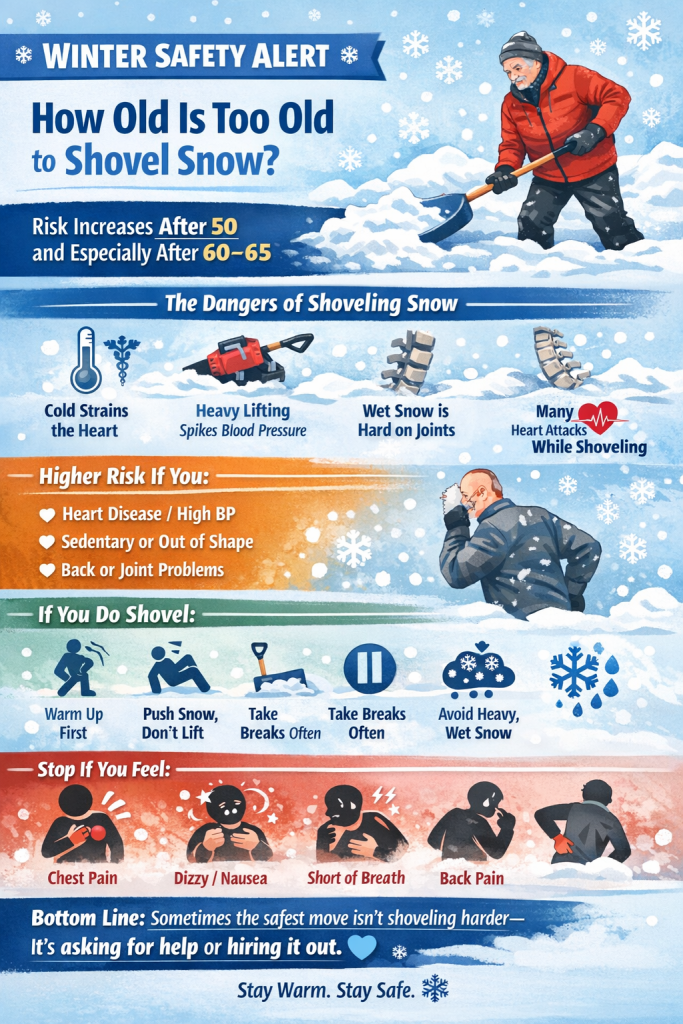
There’s no specific age when snow shoveling suddenly becomes unsafe—but risk rises sharply after age 50, and especially after 60–65. Shoveling combines cold exposure, heavy lifting, and sudden exertion, which can significantly increase blood pressure and strain the heart. In fact, many winter-related heart attacks occur during or shortly after snow shoveling.
Older adults, people with heart disease, high blood pressure, joint issues, or who are deconditioned should avoid shoveling altogether or take frequent breaks, push rather than lift, and avoid heavy or wet snow.
Bottom line: If you get short of breath, dizzy, chest tight, or back pain while shoveling—stop. Sometimes the safest choice isn’t toughness… it’s calling for help or hiring it out. ❄️💙
Before getting out to do a strenuous workout like snow shoveling, it is important to warm up with some dynamic stretching. Dynamic stretching involves going through movements that simulate the activity that you will be performing. For example you would want to move through some rotation movements to make sure the muscles in the lower back are sufficiently warmed up prior to snow shoveling. Static stretching involves holding a stretch for an extended period of time (15-60secs). Static stretching is more beneficial following the activity (snow shoveling) when you are warmed up and ready to cool down. For more information on dynamic and static stretching check out: We're not pulling your leg....it's stretching.
The most important thing you can do to prevent back injuries is to keep your back straight. The lower back is in it's most vulnerable state when it is bent forward (flexion). Adding rotation (twisting) to flexion increases the load on the back and puts even more stress on the back. Try to limit the amount of rotation you do while in a flexed forward position by waiting until you are upright to rotate.
In order to give your spine the stability it needs you must brace the core muscles. To learn how to brace your core muscles check out this video: abdominal bracing. Abdominal bracing will give you the support that you need to lift a heavy weight (snow in this case) out in front of your body. Make sure that you are not sucking you abdominal muscles in; this will decrease your stability and leave your lower back vulnerable to injury.
Our butt muscles are big for a reason, they are there to help up in situations like lifting heavy weights. Because many of us sit the majority of the day we are not accustomed to using our glute (butt) muscles. When going into a lift--like snow shoveling-- you want to sit back into the lift instead of leaning forward. This position will allow you to recruit the glut muscles and decrease the stress on the lower back.
Keep your knees behind your toes: We've talked a lot about how to prevent low back injuries, but what about the knees? Typically the repetitive stress injuries to the knees don't show up at the time of an injury like low back injuries do. Knee pain often shows up the next time you put stress on the knees (e.g. going up stairs). To prevent injuring your knees it is important to keep the knees from going over the toes when you squat. When the knees go over the toes, there is increased load on the knees which leads to inflammation and ultimately knee pain.
Hiking the shoulders up while lifting is very common (especially in the cold) and can lead to shoulder impingement and neck injuries. After you brace your core, make sure your shoulder blades are pulled back toward your spine (midline) and down toward your lower back. This is the place of strength for your neck and shoulders and will prevent unnecessary stress and injuries.
After being out in sub-zero temperatures the last thing you will want to do is put ice on an injured area, but it is exactly what you need to do. Injuries to the muscles and supporting structure cause inflammation, which causes pain signals to fire. Limiting the inflammation will decrease the pain.
Keep moving: Bed rest has been shown to have negative effects on recovery. You do want to keep moving but "no pain no gain" is not the mantra you want to follow. You want to move slowly in a pain-free range of motion. Light stretching and gentle movements will help you recover faster and decrease the firing of pain signals.
Anti-inflammatories: There are a number of over the counter anti-inflammatory medications on the market, (eg Advil, Motrin etc). While these medications do have anti-inflammatory properties they also present significant risks. Specific foods and supplements have been shown to decrease inflammation in the body and promote healing; for more information see Dr. Weil's Anti-Inflammitory Diet page. In our office we use a natural anti-inflammatory enzyme supplement called Wobenzyme N.
We hope that the above information will help you make it through this winter season injury-free. If you do need our help please contact us and we will help you get back on your feet.
Ever since we discovered the slow-mo feature on the my iPhone we have been having a lot of fun with it as you can see from the video below.

What does it mean to be resolute?
One of my favorite definitions: admirably purposeful, determined, and unwavering.
Wow, who would not what to be admirably purposeful?
This time of year I start asking around about resolutions and the answers are wide ranging from complete acceptance to utter avoidance. For some the beginning of the year is a time to hit the reset button and wipe the slate clean and for others it is a time to be annoyed by all the people who ask about resolutions. Whenever I find a topic that brings such variations in response, I try to figure out what is at the core of these very different emotional responses. Could it be that people just really just hate New Years Resolutions for no particular reason or is there something more profound going on here?
If it was just a simple hatred of resolutions it wouldn't give me a whole lot to write about, so I'm going to assume that there is more to this disdain than what meets the eye.
People like doing what they are good at and tend to gravitate toward these types of activities. For some planning and goals setting is their forte, but for others it is seen as just another way to fail. It is easy to think back to the years past and all the failed resolutions and want to avoid this disappointment like the plague, but it might not have to be this way.
Why do we fail at our resolutions?
There are a number of reasons fwhy we are unable to keep our resolutions, but I am going to talk about two, taking on too much and not being specific. Here is an example; I want to get healthy, sleep better and be a nicer person. These are all great goals, but they are not specific or actionable. In order for us to feel good about the sacrifices we make as we work toward our goals we have to have little wins along the way, like the mile markers that remind us that we are making progress and moving toward our goals.
Stanford researcher, BJ Fogg, showed us that breaking down a goal into a habit, and then placing structure around that habit will increases the odds of success. Before you can be healthy you need to create smaller habits that will lead your toward your ultimate goal of being healthier. In most cases we know what we need to do, but we don't do it. For example, I want to be healthier is such a huge and loosely defined goal that it is hard to know where the mile markers are therefore the positive re-enforcement is almost impossible to acquire. It is important to keep the ultimate goal in mind, but break it down into smaller pieces or habits, for example:
1. I am going to drink half my weight in ounces each day
2. I am going to do yoga MWF before work
3. I am going to no eat sweets during the week
BJ Fogg, showed us that we need to break down our larger goals into smaller habits which have done her, but he also told us that we need to create structure around a goal in order to be successful. This is where a great little free app called "Lift" comes in.
How can a smartphone app help me accomplish my resolutions?
Recently I discovered the app Lift and happy that I did. It is a great way to break your larger goals into smaller pieces or habits but it is much more than that. Lift allows you to join in with others throughout the world who are trying to accomplish the same thing. For example, I wanted to start a habit of flossing before bead each night. I found a group of 54K people who were also trying to do the same thing! Immediately I don't feel so alone and know that there is a community of people that I am part of who are trying to do the same thing.
There are also reminders that are set in the app. For example, every night I get a little reminder from my Lift app at 9:30pm that says "remember to floss tonight." Reminding me to floss is only part of what the reminders do, they also motivate me. Typically there will be a message following the reminder that says something to the effect of "if you check in tonight, this will be your 9th night in a row!" I can't tell you the number of times that I have been exhausted with no intentions of flossing and I get that little message that motivates me to keep up my habit.
The layout of the app is very simple. For each habit you are trying to instil, you have a huge green check button that you can click when you complete your habit and there is a sense of satisfaction when I click that button each night. Lift will also show you how well you are keeping up with your habit at a glance. This information is provided in an easy to access and understand format. A quick glance will give you the motivation that you need to keep up the good work or work a little harder.
 We all love to hear about studies that validate the health benefits of our favorite vices, especially this time of year when our favorite temptations are at every turn. If your Christmas list includes lots of chocolate this year, you might be interested to find out that there are some studies that have found specific health benefits of chocolate.
In two Swedish studies, people who ate the most chocolate had a lower risk of stroke or a fatal heart attack than those who ate the least. (The “most” was about two ounces every week in one study and at least twice a week in the other.) Now before you run out and grab a pallet of chocolate from Costco you might want to read further. These studies were observational studies which means that they can't directly correlate a decrease in cardiovascular disease and chocolate consumption, sorry. One theory is that people who have chocolate once a week are most disciplined in their intake of chocolate and possibility consuming a higher quality of chocolate that has more of the healthy ingredients.
Cocoa flavanols that are found in chocolate (higher in the darker chocolates) have been shown to improve the function of blood vessels. It is thought that these flavanols help the body synthesize nitric acid which dilates blood vessels improving blood flow. There has also been studies showing improvements in blood pressure with flavanol intake.
Should I eat chocolate for health?
Good question. There does seem to be some health benefits to chocolate consumption, but as with most things, moderation is the key. Also, most of the benefits from chocolate have come from darker chocolate that contains higher levels of flavanols. There have been other benefits of chocolate shown in studies outside of cardiovascular effects, but I will leave that up to you to do your own homework.
With the holidays around the corner make sure to eat in moderation and plan out your food week. If you know that you have two Christmas parties one week, skip the burger for lunch and opt for the salad.
Where to buy chocolate in Indianapolis?
I was surprised to find that Indianapolis and even Broad Ripple are hot beds for chocolate production.
Endangered species chocolate can be found all over the country and it actually located right here in Indianapolis! If the health benefits of chocolate are not enough for you maybe you can feel good about saving an endangered species.
If you are looking for the "rarest chocolate in the world" check out local Chocolate for the Spirit. You can find it at the Broad Ripple Farmer's Market, Goose the Market or directly from their website.
If you are looking for a great chocolate selection after your next visit to Compass, stop by The Fresh Market for a wide selection of various types of chocolate. This is dangerously close and I have been known to shoot over for a chocolate bar from time to time. My most recent bar had an interesting and tasty addition, check it out here.
This recipe has been a staple around our house for many years.  It is a very simple recipe and tastes much better than you might expect due to the simple list of ingredients. You do need a clay pot to make this recipe, which is pictured to the left. Typically the run $30-50 new or you can often find them in thrift stores. You can get a better idea of pricing at amazon.com.
We make this recipe on a Sunday and have it as leftovers throughout the week and it will also freeze well.
Click Clay Pot Jambalaya to download the recipe.
 Here is the finished product!
 by Aaron Day
This month’s focus is dedicated to all the cyclists, runners, weekend warriors, and sports enthusiasts that endure the long hours of work to finally get to that point in their day that they can truly call theirs. The point of which the overabundance of sunshine, warmth, and fresh air is like a welcome mat to the endless landscapes of the great outdoors. I’m talking about when we are off the clock, and feeling the wind blow through our hair as we are racing along on our bicycle, or pushing for that last mile in preparation for the next big run. More specifically, we are going to focus on the preparation that is often misunderstood, or even overseen as a whole.
What is the difference between Static and Dynamic stretching?
We are talking about stretching. Specifically Static and Dynamic Stretching, and how they can be most effective when used with a pre-participation protocol. The parameters of the protocol require two things: warm up, and stretching. The warm-up is to increase internal body temperature, and stretching is to increase muscle and joint Range of Motion (ROM).
I’m sure some of you may be thinking, ‘stretching, warm ups, I haven’t cared before, why care now?’ Studies from the National Institute of Health (NIH), and sub-studies within the NIH states that participants that are actively involved with appropriate warm up and stretching activities have a greater chance of not sustaining musculoskeletal injures than those who don’t. There are no specific guidelines or definite evidence that proves that one stretch is better than another, but many hours and multiple studies have led us to a conclusion that although pre activity dynamic stretching can help reduce musculoskeletal injuries, but it cannot prevent overuse or some acute injuries.
Why should you utilize Dynamic Stretching?
According to the University of Virginia, dynamic stretching involves continuous movement throughout the exercise; which is considered more effective than static stretching in warming-up and increasing blood flow to the region. Dynamic stretching also promotes increased flexibility for multiple muscle groups at a time.
These exercises are most often used to prepare the body for physical exertion before an athletic performance. One theory from the University of Virginia suggests that stretching muscles by using movements similar to those that occur within their athletic competitions accustoms the body to those movements, and in return improves oxygen flow, strength, balance, and overall performance.
Although not fully guaranteed, Injuries during competitions have been reduced due to pre-performance dynamic stretching.
When should you utilize Static Stretching?
Static stretching is a type of stretching that we do when the body is at rest, like bending over to stretch your hamstrings, stretching your calf up against the wall, or standing there holding one leg to stretch our quad. The most valuable time would be as a cool down from your recent exercise. The Australian Institute of Sports suggests that static stretching could also be paired with a dynamic stretching routine before performance without the possibility of hindering your performance.
Another thing to think about when putting together a good stretching routine is the timing and duration. Despite the ridiculous diet and all the rigorous training you endured for weeks at a time, stretching and warm-up at the appropriate time(s) could be all that stands between you and that Personal Record (PR)!
Studies show that static stretching between 30-60 seconds is optimal, with a slight decrease in performance shown when holding a longer than 60 seconds. And, for your muscles, fast/slow twitch muscle fibers, and the rest of you body to receive maximum benefit of stretching, allow 5-10 minutes before the actual competition to perform a couple movement-specific static and dynamic stretches.
Stretching should not be put off until there is a sporting event, stretching should be done all the time! We put our bodies through countless hours of sitting, hunched over our desk hacking away at the computer, driving in our cars, cooped up in meetings, or taking the next flight out of Indy. Static stretching is good for this! Take some time out of your day to do 5-8 stretches, hold for 10 seconds, just to wake up the muscles, let them know you love them! You’ll appreciate it, I promise! But, the better flexibility we maintain, the better we’re going to feel, and the longer our bodies can last (in some situations).
We shouldn't look that static or dynamic stretching as an East Coast vs. West Coast rivalry, “right way to stretch” or “the wrong way to stretch”, nor as a burden that takes up an extra ten minutes of our time. No, we should view stretching as a way for us to get in touch with our body, a way for us to physically prepare ourselves for the achievements we are about to achieve and the beatings we are about to give, and as a way to prevent injuries.
As health professionals, we practice and recommend stretching almost daily; it has become a routine for us, and we hope with all the work and research we provide to the public, that they will consider appropriate stretching as a part of their sports and personal lifestyle.
by Dr. Bryan Bingham DC
Eat breakfast like a king, lunch like a prince and dinner like a pauper. Does this sound like your typical day? If you are like most people you've flipped the script on this old adage starting your day with little or nothing of substance and ending your day with a huge meal a couple hours before you sleep.
This typical American diet pattern works great for one thing, putting on fat. Ask a Sumo Wrestler how they put on so much weight. You might think that Sumo Wrestlers have a unique genetic makeup that allows then to grow much larger than the typical Japanese person, not the case. Sumo Wrestlers purposefully exercise with empty stomachs and gorge themselves just before bed in order to get as big as humanly possible. The typical American approach to daily eating is very similar to the Sumo method, but without the exercise, so we end up looking more like the guy on the right instead of the guy on the left.


Who has time to eat like a King in the morning? You do and so do your children.
The food that we eat in the morning sets the stage for the rest of the day. It should be no surprise that you go running for your 2pm sugar rush considering that everything that you have eaten causes tremendous peaks and valleys in your blood sugar. To understand the effects on your blood sugar, watch my video on The Glycemic Index.
We need to start our days with foods that will carry us through and not leave us craving for the next hit of processed sugar that is wrecking our bodies and perpetuating this cycle.
Below is a picture of the ingredients that I put in my daughters oatmeal this morning. This breakfast is packed with good fats and omega 3s that help stabilize blood sugar, decrease inflammation and protect the brain. I also add cinnamon because it has been shown to help regulate blood sugar and local honey to help with allergies. This meal takes me less than 10 mins to make and my daughter can't get enough of it. Oatmeal is a great starting point and you can add just about anything.
The ingredient that you can't see behind the coconut oil is Chia Seed, which is high is omega 3s.
Try out your favorite foods and let me know what works for you!

In this video Aaron shows us how to massage the muscles of the calf on your own. If you want to learn more about sports injuries, check out our sport injury page.
 What if you couldn't take a normal first step when you get out of bed in the morning? Instead, you have to resort to the "Stingray shuffle" until the agonizing pain in the bottom of your foot subsides. Better yet, imagine if you are currently having the athletic-performance of a lifetime, until you were unable to finish solid because of the sharp, stabbing pain throughout the entire length of your foot, and up into your heel... Devastating, I know. There is a high chance that you may be suffering from a painful but treatable condition known as Plantar Fasciitis.
Plantar Fasciitis (PLAN-tur fas-e-I-tis) involves pain and inflammation of a thick band of tissue, called the plantar fascia, which runs across the bottom of your foot and connects your heel bone to your toes. Its function is to provide static support of the longitudinal arch and shock absorption.
There is not a single-direct cause of plantar fasciitis, but there are multiple known factors that play a major role in acquiring this condition. Some of the most common factors include: poorly fitting shoes, tight Gastroc. and Soleus (calf muscles), flat feet/poor arch strength, overuse, and excess stress from weight bearing exercise.
If ignored, or not treated properly, plantar fasciitis will continue to occur and wreak havoc on you and your feet until further, more serious measures are taken, such as: Laser Therapy, Shock Wave Therapy, Plantar Fascia/Heel Injection, or a Plantar fasciotomy.
Coming from personal experience, I highly recommend taking control of the situation before it gets worse, we only have one pair of feet, treat them kindly! Attached below is a plantar fasciitis protocol that explains in further detail what this condition is, recommended treatment options, and alternative suggestions for prevention and care of plantar fasciitis.
To download our Plantar Fasciitis treatment protocol Click Here.
As a follow up to our blog post, "Is your laptop a pain in the neck," we look at the ubiquitous smart phone and the ergonomic challenges that come with using these handy little devices.
Remember that you head is the weight of a bowling ball and hanging it over a smart phone looking down will inevitable lead to tight muscles, joint dysfunctions and even headaches.
Enjoy the video and remember to keep you head up!